

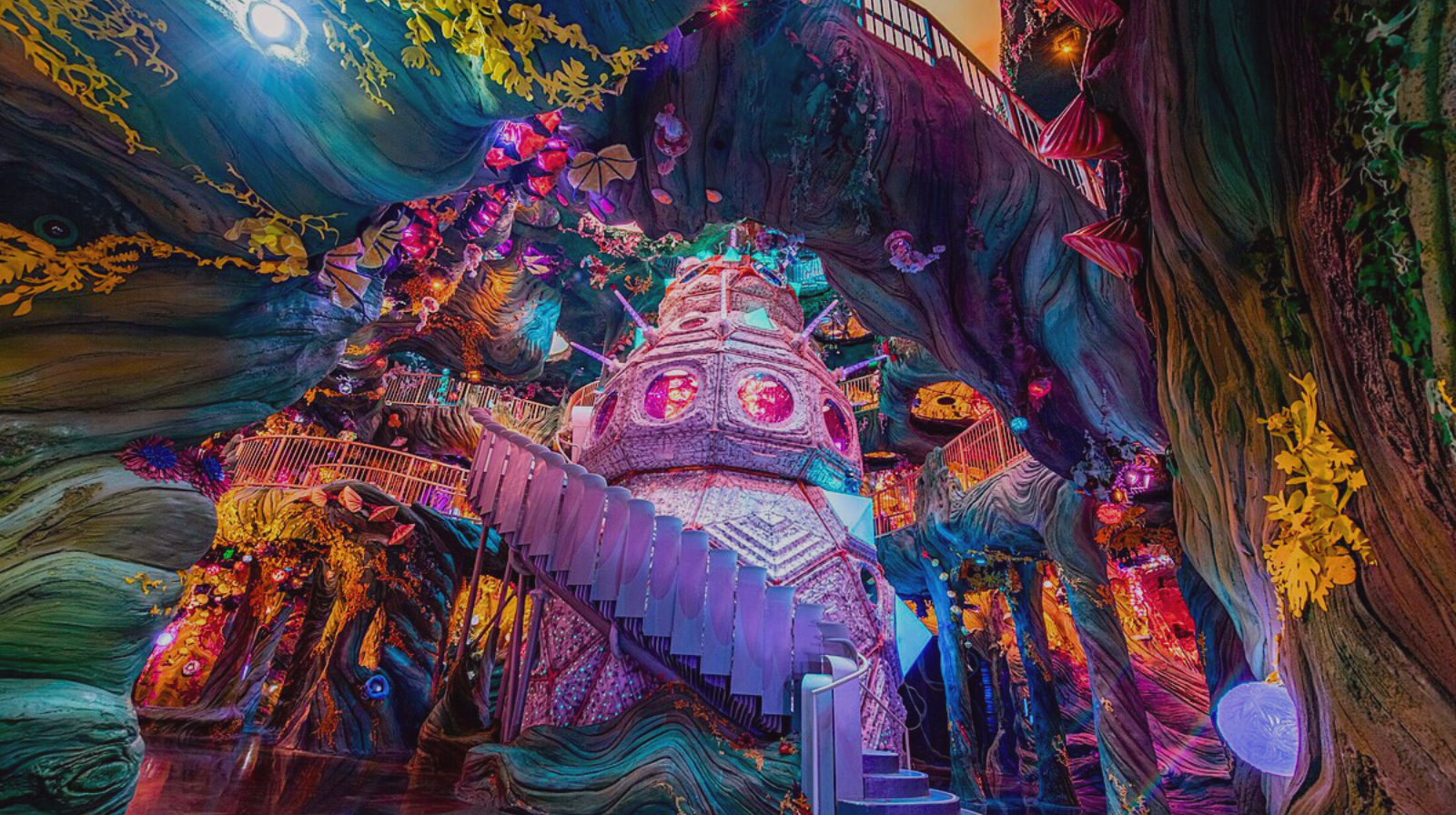
Last week, the Meow Wolf Workers Collective took to Instagram to alert supporters the company is eliminating all in-world security presence across its immersive art exhibits, a decision that will remove the first and fastest responders to medical emergencies, altercations, harassment, and accessibility crises from the labyrinthine spaces where visitors wander. Security staff will now be posted only at guest entry points, leaving the dense, disorienting interiors of Meow Wolf’s installations without trained personnel present to intervene.
In justifying the cuts, Meow Wolf management has reportedly compared its installations to Dave & Buster’s, the Museum of Ice Cream, and Chuck E. Cheese. For what began as a collective of artists radically reimagining what art could be, that comparison lands like a eulogy.

The Safety Question
According to the Meow Wolf Workers Collective, management is eliminating security officers from inside its installations, framing the decision as an improvement to guest experience. The company has shared no data to support this claim, despite union requests for incident reports, guest-experience metrics, and security logs. This requires accepting a curious proposition: that wandering through a 90,000-square-foot labyrinth of hidden passages, climbing structures, and deliberately disorienting sensory environments will somehow become safer and more pleasant with fewer trained personnel present to help when something goes wrong.
But these are not conventional museum spaces with clear sightlines and predictable foot traffic. Meow Wolf’s installations are deliberately designed to disorient, threading visitors through hidden passages, climbing structures, and mirrored corridors while layering bright colors, flashing lights, altered visual perspectives and loud soundtracks into an all-encompassing sensory experience. The intensity is significant enough that Meow Wolf pursued and achieved Certified Autism Center status across all five locations to accommodate guests who might become overwhelmed. The company’s own accessibility documentation warns of ‘several steps up and down, as well as a variety of flooring textures that may restrict mobility’ and urges visitors to ‘explore with caution,’ while its code of conduct instructs guests to ‘report inappropriate behavior to the nearest staff member or security guard.
“‘It is unsafe for our guests, unsafe to our employees — it is unsafe — because Meow Wolf exhibits are dark, twisty, intense and loud,’ union executive vice president Michael Wilson told the Santa Fe Reporter. ‘People are going to get hurt.'”
This is why in-world security officers have been stationed inside these installations, performing different functions from the guards supervising entrances and exits. According to the union, they handle medical incidents, guest altercations, harassment and accessibility needs as they arise; the company’s own operations director has confirmed they are trained to de-escalate overwhelmed guests. With those positions eliminated, that intervention capacity vanishes from the exhibition floor entirely.

The union has been warning about this since the previous round of layoffs gutted floor staffing. In December 2024, they urged the company to “prioritize guest safety in our exhibitions by increasing the number of staff on the floor,” citing a pattern that had already become alarming: “several guests have been forced to call emergency services to get medical aid because, following a round of layoffs earlier this year, our exhibitions are now chronically understaffed, leaving our spaces unsafe and poorly maintained.”
Theme park security professionals train extensively in crowd management, emergency response, and conflict resolution precisely because response time determines outcomes. Their role, according to industry safety guidelines, centers on “efficiently managing crowd control to prevent injuries in densely crowded areas, and ensuring prompt medical assistance is available in case of accidents.” At Disney parks, medical teams routinely arrive within minutes of an incident because they’re stationed throughout the property rather than clustered at entry points. In an installation like Convergence Station, where guests navigate four floors of mirrored corridors and hidden rooms, the difference between a two-minute response and a ten-minute response is not a matter of convenience.
Security workers in Denver and Las Vegas have already been informed that their positions are being eliminated, while workers at other locations await word as negotiations with the union continue. The company has gestured toward “staffing up for events,” a promise that according to MWWC executive vice president Michael Wilson means bringing in contract security partners unfamiliar with the installations rather than retaining the full-time employees who have learned every hidden passage and blind corner. Wilson believes this approach violates the union contract requiring the company to lay off contractors before full-time workers: “Their whole plan to make this work is to hire contractors to fill the gaps, which is another violation.”

The Disney Paradox
Meow Wolf’s executive leadership has never been shy about its ambitions: they want to become the next Disney Parks, the gold standard for transforming imagination into physical space. But the story of how Disney Parks was actually created is oddly under-told. Major journalism has largely ceded the territory to enthusiast blogs, company-sanctioned retrospectives, and memoirs from aging Imagineers. Everyone accepts “Disney magic” as a given without examining the specific creative infrastructure decisions that made it possible. When Meow Wolf’s executives invoke Disney as their lodestar, they’re referencing a mythology rather than a history. The actual history is more instructive.
When Walt Disney created Imagineering in 1952, he was drawing on a vision that stretched back decades. His father Elias had helped build the 1893 World’s Columbian Exposition in Chicago, and Walt himself was transfixed by the 1939 Golden Gate International Exposition, where a miniatures exhibit planted the seed for what would eventually become Disneyland.
By the time the 1964 New York World’s Fair arrived, Walt saw his opening: corporations eager to impress fairgoers would bankroll the development of attraction technology that Disney could later move to his own parks, and the fair itself would serve as a proving ground to test whether East Coast audiences had any appetite for Disney-style immersive entertainment. He convinced Ford, General Electric, Pepsi-Cola, and the State of Illinois to fund four pavilions. Out of the five most-visited shows at the fair, Disney had four. Imagineer Tony Baxter would later call it “the first golden era of Imagineering attractions.”
But the technology was always in service of something larger. To design these worlds, Walt did not hire architects or engineers first. He pulled his own artists out of the film studio and handed them the blueprints. These were storytellers who thought in emotional arcs and visual rhythm, composing every sightline and transition with the same intentionality as a frame of animation. They became the first Imagineers. Creative director John Hench would later liken the design of theme parks to filmmaking, describing the work as “The Art of the Show.” The division they built rested on a principle that corporate executives tend to forget: unforgettable immersive experiences require protected artistic space, creative continuity, and institutional memory.

This is not to suggest that Disney has remained faithful to that vision in perpetuity. Its creative shortfalls serve as evidence of what happens when corporate thinking overrides artistic instinct. But when CEO Bob Iger acknowledged in late 2023 that the company had “lost focus,” Disney restored creativity to the center and gave its teams room to execute. Here is the crucial distinction: Disney, for all its bloat and cost-cutting, still maintains Imagineering as a dedicated creative development arm. It still has its own campus in Glendale staffed with over a thousand illustrators, architects, engineers, and designers. When Disney fails creatively, it course-corrects, because its leadership understands that without the people who dream up new worlds, there is no Disney magic left to sell. Granted, Disney is no paragon of labor relations; most recently, its $1 billion deal with OpenAI drew condemnation from the WGA, SAG-AFTRA, and the Animation Guild. But in over a century of operation, the company has never gutted its creative infrastructure.
Meow Wolf has taken the opposite approach. Over the past several years, the company has imported executives from Disney and Nickelodeon at astronomical salaries while conducting three rounds of mass layoffs in three years. In April 2024, 165 employees were laid off, including creative operators, security leads, and IT staff. MWWC secretary-treasurer Jerome Morrison referred to the cuts as “draconian decisions” made by “corporatists.” Eight months later, just before Christmas, another 75 workers were cut. Under former CEO Jose Tolosa, who resigned in April after workers petitioned for his removal, the company failed to complete projects and hollowed out the creative teams responsible for its success, according to union executive vice president Michael Wilson. Board member Rebecca Campbell currently serves as interim CEO, and the company has not announced a permanent replacement.
The National Labor Relations Board has investigated at least 16 separate cases against the company since 2021 for unlawfully changing working conditions without bargaining, ignoring lawful information requests, interfering with workers’ right to union representation, and retaliating against pro-union employees. Former employees described being laid off via Zoom and escorted out by security without the chance to collect personal belongings or say goodbye. Therapy dogs were stationed in the lobby.
Disney celebrates its Imagineers as keepers of the company’s creative flame. Meow Wolf’s workers are, in their own words, treated as “pawns in some larger game.”
You cannot conjure wonder with a revolving door.

The Pattern
The workers have not accepted this quietly. The same collective spirit that animated Meow Wolf’s first installations now fuels the resistance against its executive capture.
On Halloween weekend 2025, workers at Meow Wolf’s Grapevine location walked out. For three days, during one of the busiest periods of the year for an attraction built around the strange and surreal, bartenders and security officers and guest services workers picketed outside while their employer staged its annual Cosmic Howl celebration inside. The strike followed more than a year of stalled contract negotiations and came after an informational picket earlier that month failed to move the company. “The first year we were open, Meow Wolf would preach about community and being on the forefront of social change, which really resonated with this work force,” said bartender Jack McPherson. “And over the last few months, Meow Wolf has really stepped back from those ideals, and we’re not going to let that happen without a fight.”
This past summer, nearly 70 workers at Meow Wolf’s Houston location announced their intent to unionize, joining their colleagues across all five Meow Wolf installations under the MWWC banner. It was the culmination of months of quiet organizing at Radio Tave, the company’s newest exhibition. “We want to have a seat at the table when decisions that impact our day-to-day lives are being made,” said bartender and organizing committee member Marleigh Flowers. From Grapevine, bargaining committee member Alexis Stewart welcomed the Houston workers: “We will stand together to challenge a status quo that disenfranchises workers across the state.”
The organizing momentum has emerged in direct response to what the workforce has experienced. When the company laid off 165 workers in April 2024, many of them were exhibitions staff and security, the people who manage day-to-day operations and guest safety. The union warned at the time that the cuts would “greatly impact our ability to not only make art, but to operate our exhibitions.” A year and a half later, the warning has become company policy. “When a company refuses to listen or bargain in good faith,” said MWWC President Matthew Rosvold, “workers are left with one option: to stand together and withhold their labor.”

The Collective
Meow Wolf began as an artist collective. The B-corp that now carries their name has been devoured by a corporate monstrosity hellbent on extracting, diluting, and monetizing its radical aesthetic into toothless mass-market schlock, and it treats its people accordingly.
But the collective spirit did not die with the company’s transformation. It resides in the workers who organized across all five locations and walked out at Grapevine when the company refused to bargain. Their ranks have grown with each new fight, most recently when nearly 70 Houston workers announced their intent to join the collective.
“Meow Wolf taught us art should always be a radical endeavor,” the union writes on its website. “Unionizing is an art in itself.”
As the company prepares to open locations in Los Angeles and New York, enlisting hundreds of local artists to build what it calls ‘love letters’ to each city, its leadership still hasn’t grasped that no amount of expansion can outrun a crisis of identity. How many of those artists know what they’re cosigning? Do they understand the company courting them was founded by artists like them, built by workers like them, and has since been stripped for parts by executives who never understood what made Meow Wolf so singular? The betrayal compounds with every expansion, as executives recruit new believers to build monuments to a vision they abandoned long ago.
“You can design and create, and build the most wonderful place in the world,” Walt Disney once said. “But it takes people to make the dream a reality.”
Meow Wolf’s corporate leadership would do well to remember that.
