

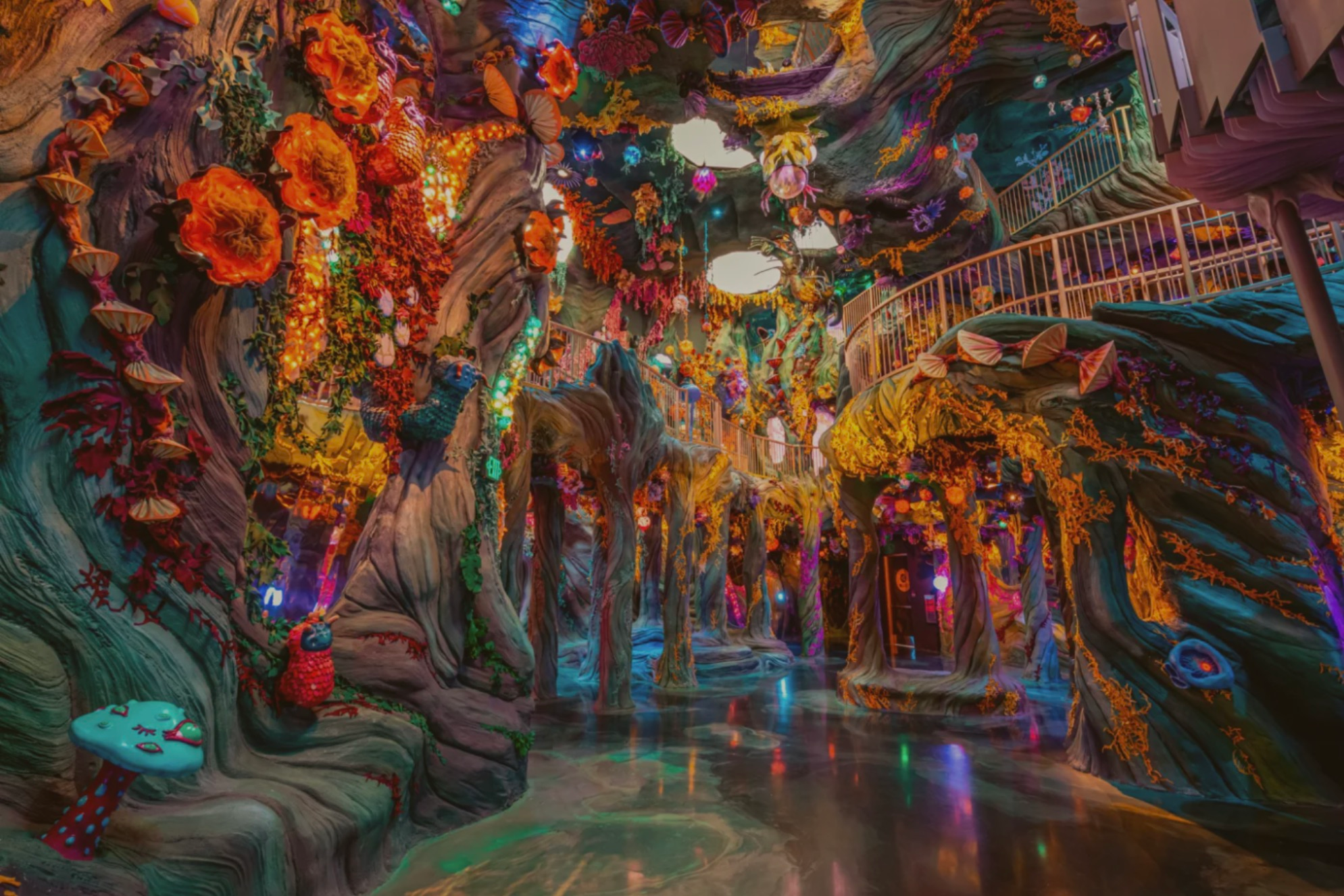
On July 24, 2025, employees at Radio Tave, Meow Wolf’s Houston outpost, filed for union recognition under CWA Local 7055, joining successful organizing efforts in Santa Fe, Denver, and Las Vegas. The organizing unit spans guest services, creative, education, and tech staff. Their demands? Stable schedules. Livable wages. Safer conditions. Real input.
“We are so excited and proud to be joining our fellow employees at the other Meow Wolf locations in forming a union,” said Marleigh Flowers, a bartender and organizing committee member in Houston. “We want to have a seat at the table when decisions that impact our day-to-day lives are being made.”
It’s a familiar battle cry rooted in both labor fairness and cultural memory. These workers remember when Meow Wolf was something radically different, and they want much more than acknowledgement for bringing its art to life.
This goes deeper than a straightforward labor dispute: workers are fighting for the soul of the company.

Origin Story
Meow Wolf was never supposed to be a multimillion-dollar entertainment brand.
Back in 2008, a group of scrappy, broke creatives squatting in an abandoned Santa Fe bowling alley started crafting surreal, maximalist dreamscapes from found materials, community donations, and pure punk ethos. They didn’t have elite art school credentials or glossy investors. What they had was plywood, paint, sweat, and a shared belief that art should be immersive, chaotic, and for everyone.
Their early installations like Glitteropolis and The Due Return didn’t just invite viewers in; they swallowed them whole. Each piece was a riotous explosion of color, sound, and surrealism. They were built by volunteers, paid in pizza. The collective thrived on radical collaboration: no fixed hierarchy, no gatekeeping, no branding.
Through these installations, they built space for misfits, outsiders, and anyone who never felt at home in the gallery circuit. It was a living experiment in mutual aid and radical imagination.

Growth and the Growing Divide
Then came the breakthrough. In 2016, with a $2.7 million investment from Game of Thrones author George R.R. Martin and millions in public subsidies, Meow Wolf opened The House of Eternal Return, a permanent installation that married sci-fi narrative with interactive spectacle. It was an overnight phenomenon, culturally and financially. What had begun as a DIY rebellion was now poised for scale.
What followed was rapid expansion: a B-Corp certification, outposts in Denver and Las Vegas, tens of millions in venture capital. By 2021, Meow Wolf was a national player in the “experiential economy.”
But with expansion came executives, org charts, and a creeping cultural shift. The company born of anarchic collaboration was now speaking the language of scalable growth. Meow Wolf still branded itself as artist-led and anti-establishment. But for many workers, the shift was unmistakable: Meow Wolf had gone from collective to corporation. And the people who had once built it were now mere employees.
Then came the layoffs. In 2020, Meow Wolf let go of more than 200 workers during the early pandemic, even as it forged ahead with construction on new sites. Disillusioned and furious, Santa Fe workers organized under CWA Local 7055, demanding livable pay, transparency, and structural respect. The company voluntarily recognized the union.
It wouldn’t be the last time workers had to fight to be heard.

Labor Builds Momentum
In 2022, Santa Fe workers ratified their first union contract: a $60,000 annual base salary for artists, a minimum $18/hour wage, grievance protections, and improved health coverage.
“A lot of them saw $20,000-a-year raises,” said CWA campaign lead Milagro Padilla, referring to the artists who make Meow Wolf possible. “We were able to fix a lot of that through the contract.”
In Denver, employees followed suit and formed the company’s second bargaining unit. Las Vegas workers also successfully unionized, making it the third Meow Wolf location with union representation.
These were powerful declarations that art is labor, creative culture doesn’t justify precarity, and values branding is meaningless if it’s not felt by the people making the magic happen.
But by 2024, discontent boiled over again. Another round of mass layoffs, this time affecting more than 150 employees, hit hard. Staff described erratic scheduling, limited advancement, and a growing disconnect between leadership’s messaging and their day-to-day reality.
Internally, the contradiction was glaring. The marketing still pulsed with psychedelic rebellion, but the worker experience had evolved into something far more corporate.
Meow Wolf, many felt, had lost the plot.

Chapter Houston: Unionization at Radio Tave
Which brings us back to Houston.
On July 24, 2025, employees at Radio Tave, Meow Wolf’s Houston location, filed for union recognition with the National Labor Relations Board. Representing guest services, tech, creative, and education staff, the unit is organizing under the same CWA Local 7055 that led successful drives in Santa Fe and Denver.
Their demands will sound familiar: stable schedules, livable wages, safer conditions, and a meaningful seat at the table.
But this campaign runs on something deeper than contract terms. The original spirit of Meow Wolf, the wild collective that changed lives, still belongs to the people who bring it to life every day. As organizer Emily Markwiese explained: “As Meow Wolf continued to find its footing as a company, we needed to do the same as workers.”
However, the company’s response has been less cooperative than in previous campaigns. In Grapevine, Texas, Meow Wolf is refusing to bargain with workers. Meanwhile, Netflix’s upcoming immersive exhibit is offering significantly better wages than Meow Wolf, highlighting the company’s failure to remain competitive in compensation. In Houston, union organizers report that management is signaling they plan to drag out the recognition process as long as possible.
Workers emphasized they organized out of love for the company, not to cause trouble. They believed Meow Wolf could do better. Yet they faced a brand that marketed that love while distancing itself from the people who made it possible, profiting from radical aesthetics while suppressing the radical workers who created them.
Joanna Garner, who spent nearly six years as a Senior Story Creative Director before leaving in December 2024, captured this tension perfectly. Writing about the layoffs on LinkedIn, she posed a question that cuts to the heart of the matter: “Does it make sense that the people who put in investments of money (board, investors) and clout/experience (executives) should be exponentially rewarded when the company’s art is successful, rather than the artists that made the art?
Make no mistake. This campaign is a confrontation with the company’s identity and with the future of creative labor itself.

The Larger Picture: Culture Workers Are Done Waiting
Across museums, animation studios, and creative institutions nationwide, labor organizers are rejecting the long-standing belief that passion should compensate for poverty and mistreatment.
Creative workers are organizing at unprecedented rates. Museums Moving Forward research shows 100% of new union elections since 2019 have been won by workers. At the Brooklyn Museum, 140 employees ratified their first contract in 2023, securing a 23% pay increase over three years and raising minimum wages to $57,630 annually. Even MoMA, where Local 2110 UAW has been organizing since 1971, recently had to fight through 122 days of bargaining just to secure museum-wide raises.
In gaming, 25,000 jobs vanished since 2023 while companies posted record profits, spurring the industry’s first sector-wide union. Animation workers marched 800-strong on Netflix. Even in Texas, Powerhouse Animation ratified the first animation union contract in a right-to-work state.
The breaking point looks different everywhere but shares the same DNA. Warner Bros Discovery’s David Zaslav took billions in write-offs, shelving completed projects like “Coyote vs. Acme” and turning years of labor into tax deductions. Philadelphia Museum workers struck for 19 days after being offered 14-cent raises while management sat on $900 million. HarperCollins workers struck through the 2022 holidays when entry-level staff were on food stamps while the company posted record profits. Condé Nast staff unionized after colleagues were laid off via Zoom while Anna Wintour’s Met Gala budget stayed untouchable.
These movements share something deeper than grievance. Workers have recognized that institutions built on collective creativity have weaponized that very passion against them. As Denver organizer Seth Palmer Harris said: “We’re trying to make sure that Meow Wolf, which started as an artist collective, remains a collective.” The Houston workers are now testing whether that’s possible. If they succeed at reclaiming power, then maybe the whole creative economy is up for renegotiation.

The Expansion Paradox: Growth Over Workers
But while workers in Houston organize for dignity and fairness, Meow Wolf corporate is making other plans.
In March 2025, just months after laying off 75 employees, Meow Wolf announced its most ambitious expansion yet: a seventh permanent exhibition at Pier 17 in New York City’s historic South Street Seaport. Los Angeles is already slated to open in late 2026. Two of the country’s biggest cultural markets, back-to-back.
When questioned about the December layoffs, a Meow Wolf spokesperson said “Our current roadmap remains on track. Future exhibitions, including those already announced, will proceed as planned.”
Michael Wilson, Executive VP of the union and a founding member since 2020, explained: “We have not finished a single project we have stated since the pandemic. In the last three years, under current leadership, we have not finished a project. Plus, we’ve had three layoffs in the last three years with two just in the last year.”
Since 2020, 436 workers have been laid off while the company aggressively expands into premium markets. Workers are expendable; growth plans are sacred.
A petition calling for CEO Jose Tolosa to resign garnered nearly 700 signatures before he stepped down and it was closed. Union officials had criticized his “his preference for a top-heavy structure of executives” that “turned Meow Wolf into a corporate revolving door for out-of-touch entertainment executives that bleeds money.” Though the company now has an interim CEO, labor relations have only deteriorated throughout 2025.
Management seems to believe it can simply outgrow the labor problems. Dazzle audiences in New York and Los Angeles so completely that they won’t ask who built the spectacle, or at what cost. But it raises an uncomfortable question for anyone planning to visit these new locations: Can you separate the art from the conditions that created it?

Reclaiming the Dream Job
Meow Wolf began as a dream: to make art that mattered, with people who mattered to each other. What the workers in Houston are doing is fighting to bring that dream back down to earth. To make it livable. To make it fair.
But they’re not just fighting for better conditions. They’re racing against a corporate machine that’s betting it can outrun its problems by going bigger. While workers organize for dignity, executives plan grand openings in Manhattan and Los Angeles. While union members demand transparency, the company announces “next-generation storytelling” for premium markets. The message is clear: growth trumps grievances.
This isn’t just about one company anymore. It’s about whether creative workers can reclaim power before they’re rendered invisible by the very spectacles they create. If Meow Wolf can expand past its labor problems, if audiences in New York and LA fall in love with the immersive art while ignoring the conditions that created it, then what’s to stop every other “creative” company from following the same playbook?
What the workers want is power, not a return to some idealized version of th past. But time isn’t on their side.
Meow Wolf’s journey from renegade collective to corporate brand raises a familiar question: what happens when art goes corporate? The Houston workers are betting they can still change the answer. Because if Meow Wolf really wants to stay weird, it needs to prove that its values extend beyond the marketing copy.
Editor’s Note: This story has been updated with details clarified by Michael Wilson, including that he serves as Executive VP of the union and has been a participating member since 2020, that the CEO petition was closed following Jose Tolosa’s departure, that labor relations have worsened under the current interim leadership in 2025, that Las Vegas workers have also successfully unionized, that Meow Wolf is refusing to bargain with workers in Grapevine, Texas, that Netflix’s upcoming immersive exhibit is offering better wages than Meow Wolf, and that management in Houston is indicating they plan to drag out the union recognition process as long as possible.
Primary Sources:
- CWA Local 7055 union communications and NLRB filings, 2025
- Emily Price, “Meow Wolf Employees Say the Company Lost Its Soul,” Fast Company, 2024
- Houston Public Media interviews with organizing workers, 2025
Further Reading:
- Alex Bhattacharji, “Inside the Meow Wolf Rebellion,” Vanity Fair, 2021
- Jason Blevins, “Meow Wolf Is Building a Business Model for Immersive Art,” Colorado Sun, 2021
- Coverage of Meow Wolf layoffs and expansion: Bloomberg, Santa Fe New Mexican, TechCrunch
