

The 2026 FIFA World Cup will bring an estimated 300,000 visitors to Atlanta. Six months out, a coalition of labor unions and civil rights organizations is demanding worker protections before contracts are finalized and the leverage disappears.
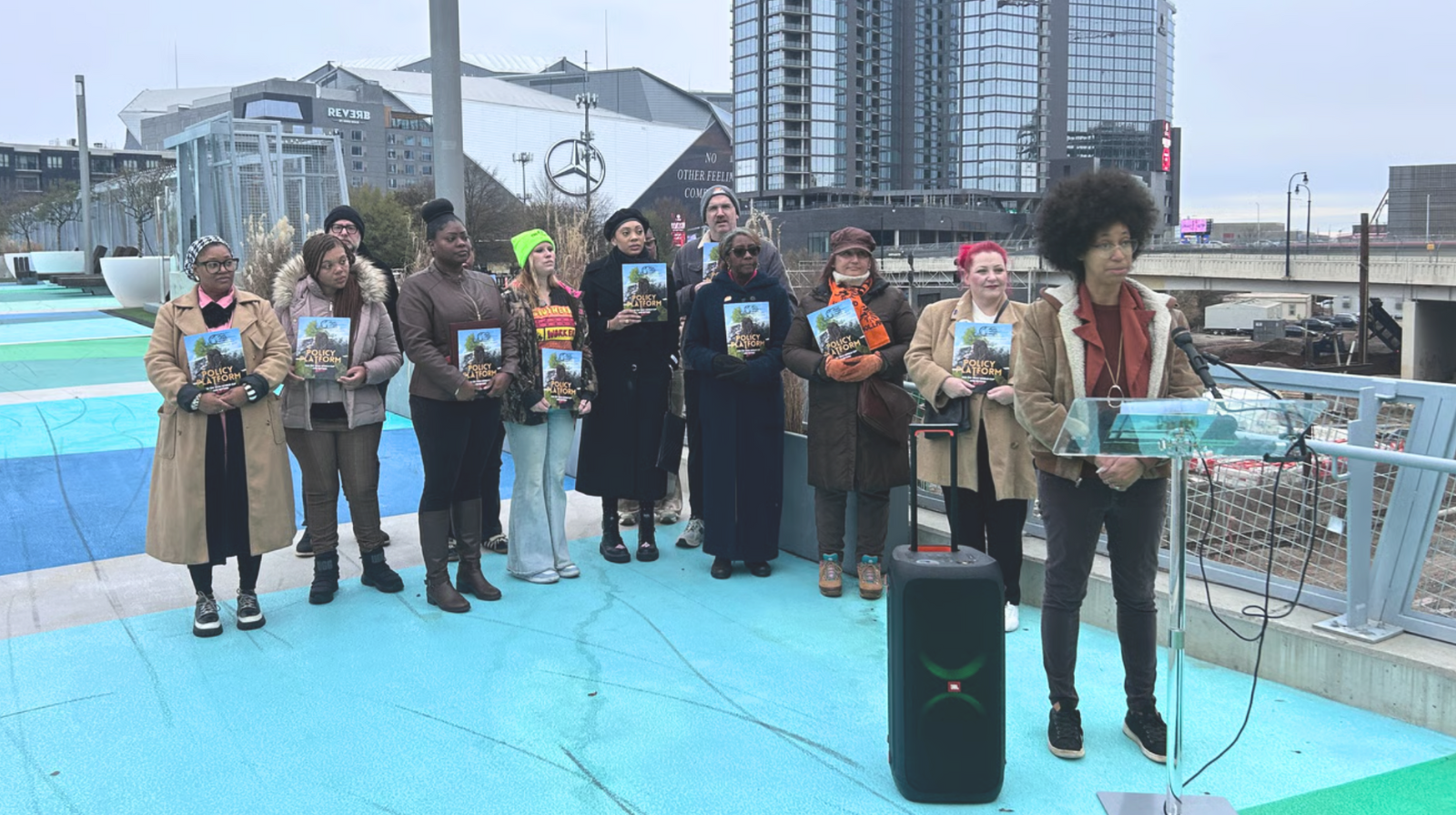
On December 4, Play Fair ATL gathered on the Steele Bridge overlooking the Mercedes-Benz Stadium to release a 16-page policy platform outlining demands for worker protections, housing stability, and immigrant safety ahead of the tournament. The coalition spans organized labor, civil rights law, criminal justice reform, and immigrant advocacy. Member organizations include the Georgia AFL-CIO, the NAACP Legal Defense Fund, the Southern Center for Human Rights, the Georgia Latino Alliance for Human Rights, and the Union of Southern Service Workers. As the city negotiates contracts, they’re intervening for the workers who will feed, clean, and secure the event. Ultimately, what gets decided now will determine whether they share in Atlanta’s prosperity or get left out.
“Our main concern is that we end up with a World Cup that is built on the backs of poor and low-income people to benefit the wealthy folks and corporate invested interests in the city,” Play Fair ATL director Michael Collins said.
The coalition is demanding a $26 minimum wage, hiring preferences for underserved communities, stronger safety protections, and enforcement mechanisms with real teeth. They’re also pushing the city to refuse cooperation with federal immigration enforcement during the tournament. With ICE raids already sweeping through Atlanta, Chicago, Charlotte, and Los Angeles, immigrant workers who will staff the event face the threat of detention for showing up to work.

What Really Happened in 1996
When the International Olympic Committee awarded the 1996 Summer Games to Atlanta, the city’s business elite saw an opportunity for urban transformation. The Atlanta Labor Council, led by organizer Stewart Acuff, saw an event built on workers’ labor that threatened to exclude them from its benefits.
Georgia is a right-to-work state, meaning ACOG had no legal obligation to use union labor. Randstad brought in over 16,000 temp workers for the 1996 Olympics, none of whom received benefits and all of whom could be dismissed without cause. The model cut labor costs and insulated sponsors from liability, leaving workers with poverty wages and no pathway for recourse. Three decades later, temp staffing has only grown in popularity for sporting events.
The agreement covered only half of Olympic construction. For the service workers who would feed, clean, and protect the Games themselves, there was nothing. Immigrant workers recruited to build Centennial Olympic Park had little recourse to report unsafe conditions or wage theft.
Successful union organizing depends on stable communities where workers know and trust each other enough to take risks together. Many Atlantans targeted by police were the same workers who might have staffed the Games and organized for better conditions. Before the Opening Ceremonies, police arrested over 9,000 individuals on citations pre-printed with the words ‘African-American, male, homeless’. By the Opening Ceremonies, roughly 30,000 residents had been displaced. A federal court ruled the operation unconstitutional in 1998, two years after the world had gone home.
Stewart Acuff went on to become the AFL-CIO’s national organizing director. The construction agreement, which secured union wages for half of Olympic jobs and set aside ten percent for community residents, is remembered as labor’s biggest victory ever in the South. Today, the workers who will serve the 2026 World Cup face the same choice their predecessors faced three decades ago. Organize now, or accept whatever terms get handed to them.

Human Rights on Paper, Retrenchment in Practice
The 2026 World Cup was billed as a turning point for FIFA. For the first time, the organization incorporated human rights criteria into the bidding process, requiring host countries to commit to the UN Guiding Principles on Business and Human Rights. In turn, each of the 16 host cities was required to develop its own human rights action plan.
When FIFA cancelled its anti-discrimination messaging at Club World Cup venues without explanation, it reversed course from the 2022 and 2023 World Cups. Weeks later, homophobic chants erupted at Mercedes-Benz Stadium during a match between Borussia Dortmund and Monterrey.
“FIFA’s decision to cancel anti-racism and anti-discrimination messaging at the Club World Cup sent a chilling signal to communities of color and all who have fought for equality in sport,” Jamal Watkins, senior vice president of strategy and advancement at the NAACP, said in a statement. “At a time when hate crimes are rising and DEI programs are under attack, FIFA should not be retreating.”
The day after Play Fair ATL’s launch, FIFA held its World Cup draw at the Kennedy Center in Washington and awarded its first “FIFA Peace Prize” to Donald Trump, whose administration has deployed the National Guard in World Cup host cities and conducted mass immigration raids across the country. Human Rights Watch’s Minky Worden described the ceremony as unfolding against “a backdrop of violent detentions of immigrants, national guard deployments in US cities, and the obsequious cancellation of FIFA’s own anti-racism and anti-discrimination campaigns.”
For the immigrant workers staffing the tournament, FIFA’s human rights framework offers no shield against the administration it just honored. Whatever safeguards Atlanta’s workers secure will come through organizing.

The Guardrails Atlanta Needs Before Contracts Are Signed
Play Fair ATL represents roughly 25 organizations covering labor, civil rights, criminal justice, housing, immigration, and the environment. Their goal, as Play Fair ATL director Michael Collins told WABE, is to ensure the World Cup “gives back to the people” and is “done in a fair, transparent, and equitable way.”
“We know the World Cup is going to generate a lot of revenue for the city,” Collins said. “We know there’s going to be a lot of jobs there. The question is what type of jobs?”
Their policy platform answers that question by pushing for a Responsible Contractor Policy that would require all World Cup contractors to pay $26.10 per hour or the prevailing wage, whichever is higher. Beyond the hourly rate, the platform targets the structural barriers that have historically left service workers vulnerable. It would require proper W-2 classification to prevent employers from dodging benefits through contractor misclassification. On enforcement, it would disqualify companies with recent labor law violations from bidding and establish expedited union elections. For immigrant workers, it demands protections against retaliation for reporting violations.
Because the city oversees its police, housing policy, and labor standards for contracts, it remains the coalition’s primary leverage point. So far, Collins and his team have met with the city’s DEI department and its World Cup project management team. But he remains clear-eyed: “There is a gap between what the city says and what the city does.”

How Workers Can Win Before the World Arrives
“We will not let history repeat itself,” Mariah Parker of the Union of Southern Service Workers told a crowd at the No Kings Rally in October. “We know that these eight games coming to Atlanta next summer each have the estimated impact of a Super Bowl. And who should that money go to? It’s got to go to the people. It’s got to go to the people who make this city run.”
Play Fair ATL is part of Dignity 2026, a national coalition of 16 labor, community, and human rights organizations including the AFL-CIO that has been pressuring FIFA to enforce labor standards across all 16 host cities. “From stadium construction to match day operations, workers at every level deserve fair wages, safe conditions, and the right to organize,” the AFL-CIO’s International Director Cathy Feingold said in a statement ahead of FIFA’s World Cup draw. “We need binding commitments, not just promises.”
The coalition organizing now has months of lead time before the event and a specific platform of demands. Whether that pattern repeats depends on what transpires in the next six months.
The world will be watching next summer. So will the workers.
