

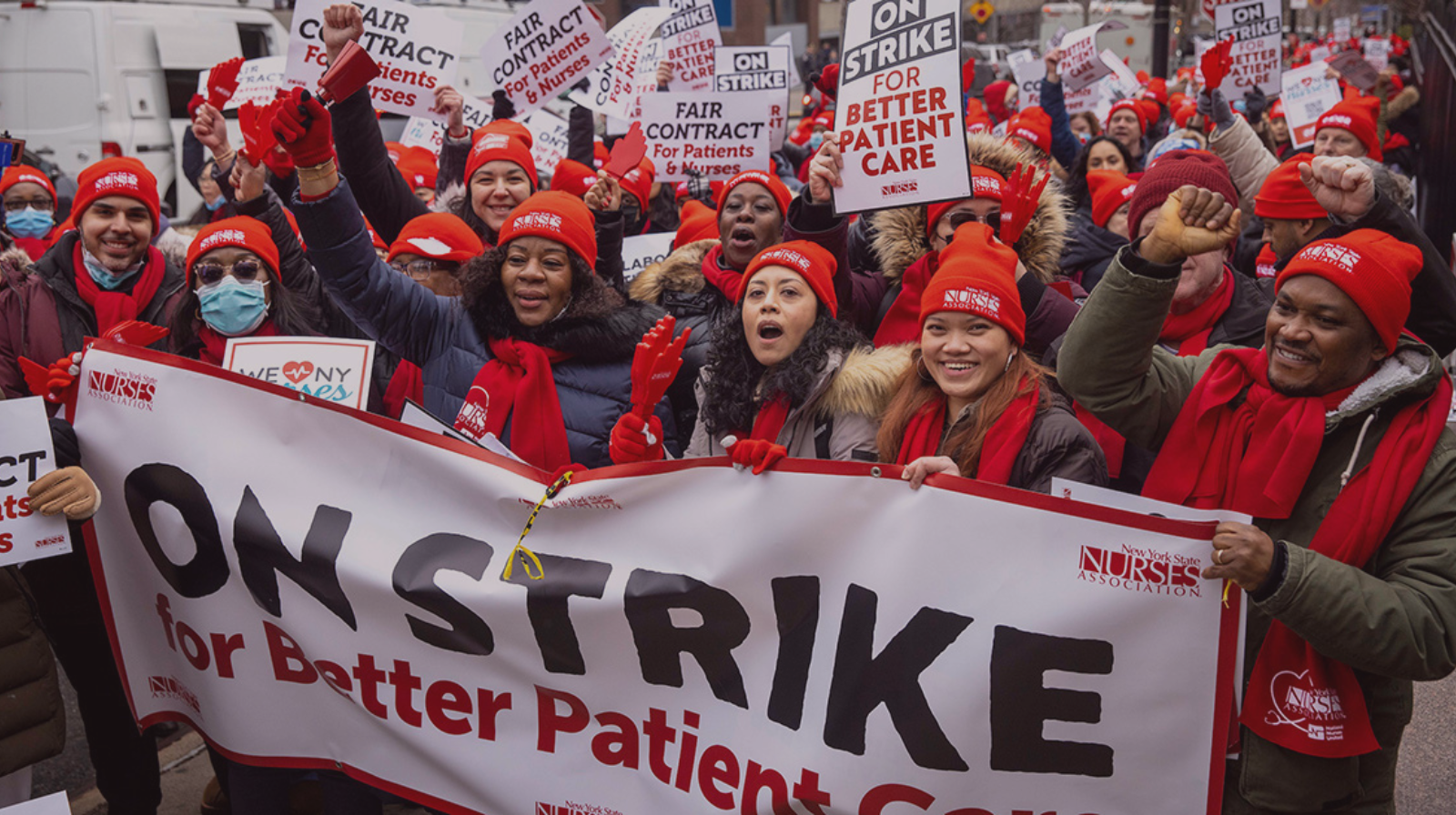
In October 2025, more than 31,000 nurses and healthcare professionals at Kaiser Permanente walked off the job in the largest strike in their union’s 50-year history. The health system, holding $66 billion in reserves, had offered a 21.5 percent raise over four years. Workers rejected it. While the wage increase might have sufficed in isolation, it failed to address the fundamental crisis: chronic understaffing that forces nurses to ration care, deciding who gets help now and who waits, even when everyone needs attention.
The Kaiser strike signals healthcare’s emergence as the vanguard of American labor. In 2023, unions filed the highest number of healthcare representation petitions in a decade. Between 2000 and 2022, only 2 percent of union petitions involved attending physicians. In the past two years alone, physicians’ unions have accounted for 23 percent of all petitions. At the end of 2024, residents and fellows along the East Coast won eight elections in a matter of weeks, including a resounding 407-85 victory at Beth Israel Deaconess Medical Center in Boston.
This organizing surge outpaces every other major sector. While Amazon warehouse workers struggle to establish their first union foothold and Starbucks battles store by store, healthcare workers are unionizing entire hospital systems at once. Hospital nurses represented by unions grew from nearly 500,000 in 2019 to 590,000 by 2025. The sector that sustained the nation through a pandemic now demands someone sustain them in return.

The Power of Concentrated Capital
Healthcare consolidation created both the conditions for exploitation and the leverage for resistance. Five insurance companies now control half the market. Hospital mergers have produced regional monopolies that dominate entire metropolitan areas. Private equity firms control thousands of medical practices, imposing productivity metrics designed for assembly lines onto examination rooms.
This concentration generates extraordinary vulnerability to collective action. When 75,000 Kaiser workers threatened to strike in 2023, they forced management to the table precisely because they weren’t disrupting a single facility but an entire integrated system serving 12.7 million patients across eight states. Though averted with a last-minute deal, the crisis erupted again in October 2025 when 31,000 workers actually walked off the job. The same consolidation that enabled healthcare corporations to squeeze workers also handed those workers unprecedented power.
Nicole Wooten, a registered nurse at Kaiser Riverside, described the reality these systems create: “Nurses go home exhausted because we have too many patients to take care of. The shifts are long, the pace never slows, and there’s always one more call light, one more chart, one more medication to give. You move from room to room like you’re on a timer — because you are.”
Starting in the 1990s, hospitals began importing efficiency methods from auto manufacturing. Virginia Mason Medical Center’s leadership traveled to Japan in 2002 to study Toyota’s production methods, translating assembly-line principles into healthcare operations. The same methods that minimized parts storage now determine nurse staffing levels, while software tracks nurses’ movements through hospitals the way Amazon monitors warehouse workers. The industrialization of care transforms patients into widgets and nurses into production units. When efficiency metrics override patient care, healthcare workers suffer moral injury.

Even Physicians Are Organizing
For most of the 20th century, physicians stood apart from the labor movement. Professional autonomy, social prestige, and substantial incomes rendered unionization unnecessary. Today, physicians who once ran their own practices take orders from MBA-credentialed administrators who measure success in relative value units and patient throughput. Hospital systems answer to shareholders rather than communities. The profession has been industrialized, with private equity ownership transforming medical practices into revenue-generating assets.
Physician union membership rose from 5.7 percent in 2014 to 8 percent by 2024, accelerating even as overall union density continues its decades-long decline. When 70 doctors joined thousands of nurses in a 27-day strike against Portland’s Providence Health in January 2025, they won not just wages and sick leave but limits on management-imposed patient loads.
A 2024 study of physician unionization campaigns found that 85 percent cited deteriorating working conditions, 81 percent their exclusion from clinical decisions, and 54 percent patient safety concerns. Compensation, notably, ranked lower on the list. The industrialization of healthcare has pushed even privileged workers into solidarity with those they once supervised.

The Unique Leverage of Life and Death
Healthcare organizing differs fundamentally from traditional labor movements because patient safety provides moral leverage that transcends economic arguments. A Pennsylvania study estimated that implementing evidence-based staffing laws in that state alone would prevent 1,155 hospital deaths annually while saving hospitals $93 million through reduced length of stay and better outcomes. A 2021 Lancet study found that for every additional patient assigned to a nurse, the likelihood of patient death increases by 7 percent.
Before the pandemic, nearly 65 percent of medical-surgical nurses reported insufficient staffing. During COVID, that figure reached 75 percent. University of Pennsylvania researchers concluded the pandemic merely exposed decades of devastation from cost-cutting and just-in-time staffing models that treat nurses as expenses to eliminate.
“Most California nurses, bedside nurses as well as managers, believe the ratio legislation achieved its goals of reducing nurse workloads, improving recruitment and retention of nurses and having a favorable impact on quality of care,” reported Linda Aiken, the nation’s foremost nursing researcher, in her comprehensive 2010 study of California’s ratios. The research showed that California nurses cared for an average of two fewer patients than nurses in other states, directly translating to fewer preventable deaths.
During the pandemic’s peak, ICU nurses routinely managed double or triple their normal patient loads. Studies documented nurses caring for up to six ventilated patients simultaneously, when evidence-based standards recommend no more than two. This occurred while healthcare executive compensation remained unchanged, with some CEOs earning millions annually while frontline workers lacked basic protective equipment and adequate staffing.This reality transforms every contract negotiation into a public health crisis. When healthcare workers strike for safe staffing ratios, they’re not merely demanding better working conditions but defending their patients’ survival. Management cannot dismiss these demands as greedy or unreasonable when the evidence conclusively links inadequate staffing to preventable deaths. In California, where mandatory nurse-to-patient ratios were implemented in 2004, studies show significantly lower rates of nurse burnout and patient mortality compared to states without such protections.

From Factory Floors to Hospital Wards
The migration of labor power from manufacturing to healthcare reflects a deeper economic transformation. As historian Gabriel Winant documents, when factories shuttered across the Rust Belt, healthcare absorbed both the workers and the human damage left behind. Former steel towns became nursing home capitals. Where factories once dominated the skyline, hospitals now anchored entire economies.
For most of the twentieth century, the iconic image of American labor was a man in a hard hat. Factories and steel girders represented national strength and economic might. The mythology of work centered on production, transforming raw materials into goods that built the visible world. This iconography of masculine industrial labor dominated American cultural representations from the 1930s through the postwar era. As that world collapsed, healthcare rose from its ruins to become the new economic center, yet without the cultural recognition afforded to industrial work. By 2020, healthcare employed nearly 20 million Americans, more than manufacturing and construction combined.
When factories closed throughout the 1970s and 1980s, younger workers fled for opportunities elsewhere while older workers stayed, trapped by mortgages, pensions, and communities they couldn’t abandon. In Pittsburgh, union seniority rules protected those who remained even as the work disappeared. By 1990, Allegheny County had become the nation’s second-oldest urbanized county. Hospital utilization surged alongside addiction, housing insecurity, and cardiovascular disease. Between 1979 and 1987 alone, the U.S. lost over 1.5 million manufacturing jobs. The healthcare system expanded to manage these populations rendered surplus by economic transformation.
The healthcare workforce emerging from deindustrialization rested on feminized labor decades in the making. As family wages disintegrated, women entered healthcare because their earnings had become essential for household survival. These women arrived, as Winant observes, effectively prequalified by years of unwaged family caregiving. The industry transformed what had been the unpaid labor of wives and daughters into a commodity purchased at the lowest possible price, premised on the fiction that this work required no specialized knowledge because it resembled what women had always done for free.
Healthcare work has always occupied an uneasy position in our national consciousness: simultaneously essential and invisible, highly skilled yet culturally naturalized as something women simply do. We erected monuments to autoworkers and wrote ballads about coal miners. But the women sustaining life at its most vulnerable moments existed outside the frame of cultural recognition. As labor scholar Jessa Lingel observes, “For a long time, images of union members in this country have been dudes. It’s been men — steel workers, dock workers, truck drivers. But with nurses, you see strategic unionization efforts that are tied to a woman’s profession.” Care work landed on the wrong side of the line determining which labor deserved protection.
The 1938 Fair Labor Standards Act, which established minimum wage protections, explicitly excluded domestic and agricultural laborers, occupations dominated by Black workers in the Jim Crow South. Healthcare inherited this framework of systematic devaluation.

The Crisis Beyond Hospital Walls
While nurses and physicians organize within hospital systems, a parallel crisis unfolds in homes across the country. More than 5 million direct care workers provide essential services to aging adults and people with disabilities, yet home health aides remain among the lowest-compensated workers in the economy. The median annual income for home care workers is less than $22,000. Nearly 60 percent rely on public assistance despite working full time.
The workforce is overwhelmingly female, disproportionately Black, Brown, and immigrant. Francisco Grajera, a home care worker from El Paso, testified that home care workers “have no benefits, no health insurance, no vacation time. We have nothing. If we get sick, we leave and no one backs us up. We’re not going to have anyone to take care of us.” These workers who sustain others through aging and illness face their own aging without the security they provide to others.
Denise Lugo, a certified nursing assistant with more than three decades of experience, testified to the consequences of this devaluation. Despite working full time, she could not afford health insurance for years. She skipped her own medical appointments, rationed her blood pressure medication, and depended on the local health department when illness struck. “I take care of everyone else’s loved ones,” she said, “but I can’t take care of myself.”
The devaluation reveals something we desperately avoid acknowledging: our terror of fragility. American mythology worships the self-made individual who transcends circumstance through will alone. But as legal scholar Martha Fineman argues, vulnerability defines human existence. We enter this world helpless and, if granted enough years, return to that helplessness. The body’s inevitable betrayal terrifies us: our flesh weakens without warning, the mind we trust dissolves into confusion. We know this bodily autonomy is temporary, that tomorrow we might need someone to lift a spoon to our lips, to remember our children’s names when we cannot.
Rather than face this inevitability, we construct elaborate denial. We consign vulnerability to workers we systematically impoverish, as if poverty wages might keep their reality at a safe distance.
Though federal minimum wage protections were finally extended to most home care workers in 2013, the Trump administration has proposed rules that would strip millions of those protections. Every state reports shortages of direct care workers while 700,000 Americans remain stranded on Medicaid waitlists, unable to access the home care that would allow them to avoid nursing homes. Even as demand for personal care aides is projected to grow by 43 percent through 2035, the workforce continues to shrink. The workers who could provide that care earn median wages of $11 an hour, which explains why 65 percent leave their jobs each year.

What Makes This Time Different
The healthcare organizing surge forces a reckoning with fundamental questions about whose work deserves recognition and what we value as a society. Unlike manufacturing unions that could point to products and profits, healthcare workers organize around the irreducible fact of human vulnerability.
The pandemic taught healthcare workers how cheaply their lives were valued. They were celebrated as heroes, applauded from balconies, and offered pizza parties instead of receiving staffing relief and structural change. Now they understand that hero narrative was a preemptive eulogy that cost nothing and changed nothing. And with the Trump administration now threatening to cancel collective bargaining rights and cut Medicaid, the fight has become even more urgent.
In October 2025, 31,000 Kaiser workers walked off the job in their union’s largest strike in 50 years. Three months later, 70 physicians made history by joining 5,000 nurses on Portland picket lines, the first time Oregon doctors had ever struck. After 46 days, they forced Providence to concede wage increases from 20 to 42 percent and automatic penalties for missed breaks. Workers are demanding the staffing that makes safe care possible, compensation that matches their training, and schedules that acknowledge their humanity.
The fact that healthcare workers now lead the vanguard of the labor movement should compel us to reconsider our assumptions about value, skill, and economic worth. Perhaps the most essential work was never about fabricating commodities but always about attending to one another. This forces us to confront what we’ve desperately avoided: every one of us will eventually need these healthcare professionals, not metaphorically but literally. We’re systematically impoverishing the very people we’ll beg to care for us when our bodies fail, and their current fight will determine whether anyone will answer our call when the time comes.
