

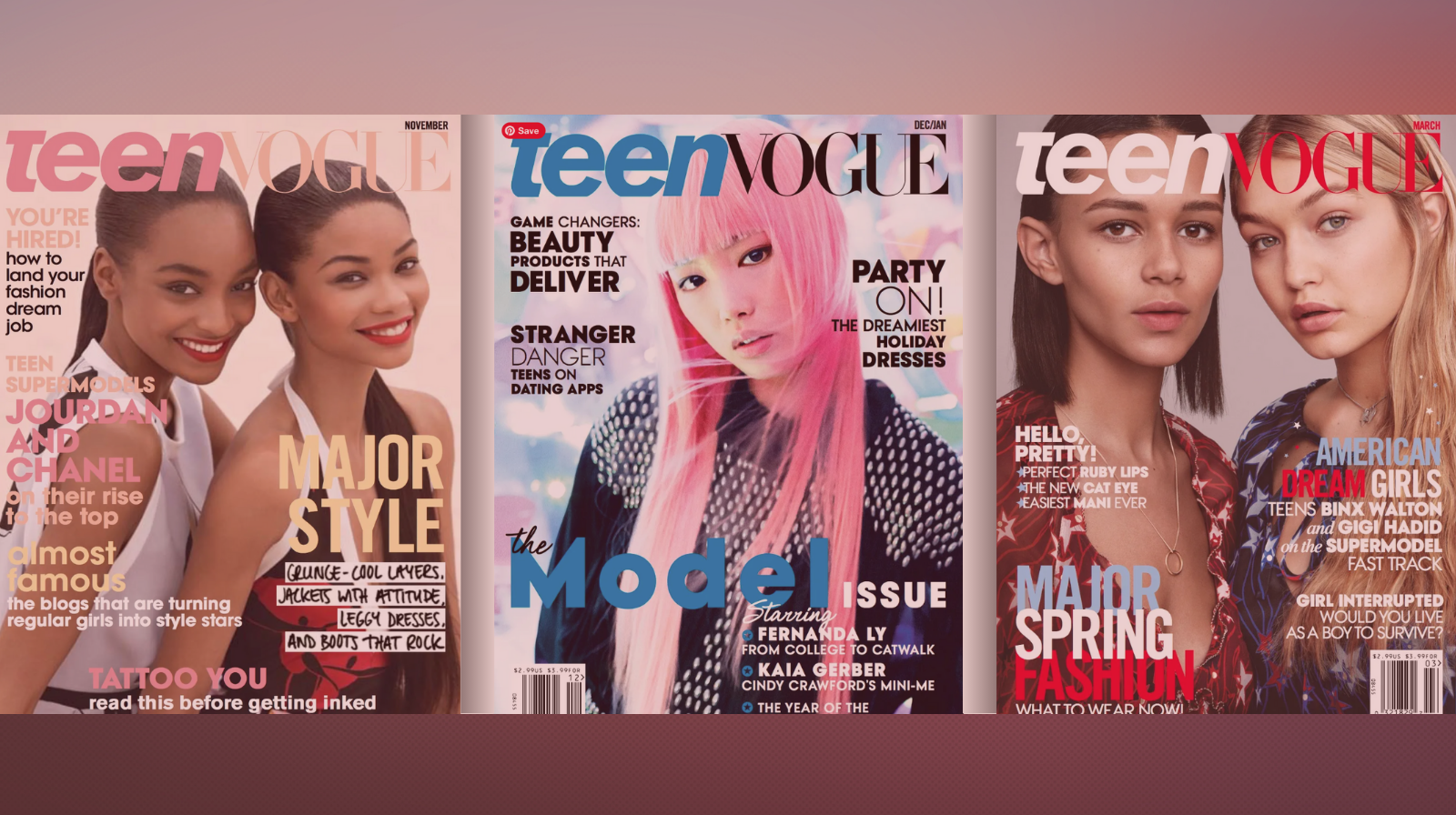
On Monday, November 3, 2025, Teen Vogue’s staff learned their publication was effectively dead. Condé Nast announced the outlet would be “joining Vogue.com, a transition that’s part of a broader push to expand the Vogue ecosystem.” This bloodless corporate-speak downplayed their true intention to erase Teen Vogue’s entire identity, displace its staff, and abandon its mission altogether.
The publication’s LinkedIn still describes Teen Vogue as “the young person’s guide to conquering and saving the world; a supportive, sex-positive, body-positive space that celebrates different identities.” But it’s hard to imagine that mission surviving when most who understood it are gone.
Within hours, the terminated journalists took to social media with a mixture of grief and fury. “I was laid off from Teen Vogue yesterday, along with 70% of my incredible team,” wrote culture editor Kaitlyn McNab on X. Politics editor Lex McMenamin, also among those cut, noted there would be no “political staffers” remaining at the publication.
Allegra Kirkland, who served as Teen Vogue’s politics director for six years until June 2025, wrote in Talking Points Memo that nearly all of her former colleagues, including all but one woman of color and the only trans staffer, were let go. The identity and politics sections were eliminated entirely.
The situation escalated dramatically when Condé Nast fired four union officers who confronted leadership seeking answers about the Teen Vogue merger. Among those terminated was Alma Avalle, vice president of the NewsGuild of New York and, to her knowledge, the only trans woman in the union. The NewsGuild filed a grievance calling the firings ‘an unprecedented violation of their federally protected rights as union members to participate in a collective action.
For a generation of young journalists, particularly women of color and LGBTQ+ writers, Teen Vogue was the rare mainstream platform that connected fashion to labor exploitation, beauty culture to capitalism, internships to systemic inequality. “Teen Vogue was my first-ever freelance byline in 2019,” wrote Aiyana N. Ishmael, the publication’s style editor who was laid off this week. “I was a junior in college and incredibly grateful to begin my career at a place that genuinely cared about having young people speak for themselves.”

The Platform That Grew Up
Created by Anna Wintour in 2003, Teen Vogue originated as a sister publication to Vogue to attract adolescent women, initially focusing on celebrity and aspirational fashion. Then in 2016, as political tensions and sociopolitical discourse intensified across the country, the magazine underwent a radical transformation under the leadership of editor-in-chief Elaine Welteroth. Expanding far beyond its glossy fashion roots, Teen Vogue amplified its coverage of politics, immigration, labor and climate change, evolving into an unexpected yet vital political voice for a generation demanding substance over spectacle.
Phillip Picardi, who led Teen Vogue’s digital newsroom from 2015 to 2018, encapsulated the publication’s mission: “We tried, every day, to let young people see the reality of our world through unvarnished journalism and uplifting voices that were traditionally underrepresented in the media. And then, we worked with fashion’s best and brightest to bring dignity and dynamism to our storytelling. We critiqued the status quo, and also flexed our imaginations.”
With Welteroth, Picardi, and subsequent editors Lindsay Peoples and Versha Sharma at the helm, Teen Vogue published in-depth reporting on reproductive rights, LGBTQ issues, campus organizing, state and national politics, the labor movement, and education. The publication understood its audience’s reality and met young people in their lived experiences. As Jasmine Rashid, author of “The Financial Activist Playbook,” noted: “Under the leadership of creatives like Elaine Welteroth, Lucy Diavolo, and more, Teen Vogue helped our generation see how beauty, fashion, and entertainment are political economies, tied to supply chains, labor exploitation, and representation.”
Teen Vogue’s readership surged from 2.9 million to 7.9 million visitors between January 2016 and January 2017, with young people ages 18 to 24 not just skimming headlines but immersing themselves in journalism that respected their intelligence.

Profit Has No Memory
The decision to gut Teen Vogue is emblematic of the brutal economics of modern media consolidation. While Condé Nast frames this as creating “a more unified reader experience,” the union representing workers calls it what it is: a move “clearly designed to blunt the award-winning magazine’s insightful journalism at a time when it is needed the most.”
Kirkland’s TPM piece details the financial reality behind the scenes: “By the time I joined in 2019, Teen Vogue had no staff writers, relying only on freelance contributors and columnists. Budgets were repeatedly cut. When art, commerce and style editors brought in lucrative partnerships and sponsor deals, the Teen Vogue team never really saw that money; instead, it went into the general slush fund keeping Condé Nast afloat.”
Meanwhile, Condé Nast has been sharing its publications’ content with OpenAI since August 2024.
Teen Vogue generated revenue, amassed a dedicated audience, won awards, yet still got starved and shuttered. “Unprofitable” apparently meant something other than losing money. As The Roosevelt Institute stated in condemning the closure: “The decision by Condé Nast today to collapse this publication into Vogue and eliminate the politics reporting staff at Teen Vogue is evidence that corporate concentration eliminates innovative ideas and silences voices with less power.”
Teen Vogue’s gutting, the fourth set of Condé Nast layoffs in less than a year, is another devastating casualty in the systematic destruction of public interest media. The pattern extends across the industry: NBC dissolved editorial teams covering Black, Latino, Asian American and LGBTQ+ communities, while CBS gutted its Race and Culture unit. NPR faces relentless attacks from politicians who weaponize budget cycles to threaten its existence and hold public media hostage to their political whims. Local newspapers have become extinction events, with entire communities losing their only source of accountability journalism. Through a labor lens, each closure represents another victory for those who need workers isolated from each other, stripped of essential information to understand their exploitation, and too exhausted to imagine alternatives.

When Platforms Fall, So Does Worker Power
Teen Vogue’s political coverage created a pipeline to labor consciousness for an entire generation. Its erasure detonates that pathway. For many young readers, Teen Vogue reframed their entire relationship to work, teaching them to see themselves as workers with rights rather than employees with obligations.
Since 2018, labor columnist Kim Kelly brought the labor beat to teenage readers through her “No Class” column, covering everything from wildcat strikes to general strikes, from the Gilded Age labor organizer Mother Jones to contemporary Amazon warehouse conditions. As Georgetown’s Kalmanovitz Initiative noted, Kelly’s work made Teen Vogue one of the best sources for labor coverage, explaining complex labor issues to a generation that desperately needed that education. Her column didn’t just report on strikes; it explained why they mattered to young workers entering an increasingly precarious job market.
Frequent contributor Taylor Crumpton reflected: “Teen Vogue was my first editorial home. The News and Politics section at the publication was my de facto journalism school. I would not be the writer that I am today without the years of investment from the editorial team at Teen Vogue who believed in me, as a young undergraduate student at Abilene Christian University.”
Through Kelly’s column, labor strikes became relevant to teenagers facing their own precarious futures. It explained labor strikes and union campaigns through the lens of young workers’ own experiences; retail hell, coffee shop exploitation, unpaid internships.
With six union members laid off, most of whom are BIPOC women or trans, Condé Nast made its position known: diverse voices discussing labor, power, and exploitation are no longer welcome in this “unified” ecosystem.

A Political Vacuum in Place of Youth Voices
The timing of Teen Vogue’s political desk elimination feels deliberately cruel. As Picardi noted: “Tonight, New York City elects its first-ever Muslim mayor, Zohran Mamdani, thanks in no small part to the young people who supported, rallied for, and powered his formidable underdog campaign. And one of the precious few publications that consistently represented youth voices in electoral politics, not by patronizing them or painting them as a monolith, no longer has the news or politics staff to cover this news.”
The Roosevelt Institute noted that “so many young people today feel ignored and disempowered in every facet of their lives, by policymakers who don’t represent their generation, by legacy media that overlooks their struggles, by online spaces that solely seek to profit from their attention.”
Without platforms like Teen Vogue, where do young workers learn to see their struggles as systemic rather than personal? Where do they discover that their unpaid internships, their gig economy precarity, their student debt, are political choices rather than individual failures?
Kirkland revealed in TPM that “weeks ahead of Donald Trump’s second inauguration, Lex and I were told Anna didn’t want to hear the word ‘politics’ in our team’s annual strategy meeting.” They abandoned political coverage precisely as authoritarianism rose. Draw your own conclusions.

The Power of This Moment
Mental health advocate Jorge Alvarez understood how powerful Teen Vogue’s platform was: he chose it intentionally for his first op-ed submission because he “knew that having an op-ed published in Teen Vogue would allow me to directly reach and speak to thousands of other young people who are looking to feel seen, to learn, and to feel empowered.” That beautiful connection between young writers and young readers has been severed.
But in the wreckage of Teen Vogue lies opportunity. Picardi suggested turning grief into strategy: “My hope for young journalists is that they leverage the power of this moment to form a coalition of artists, creatives, social savants, novice journalists, and spreadsheet/budget fanatics. Build your own ‘Yearbook Team.’ Seed funding on Patreon or Substack.” He added: “The only thing that would have made Teen Vogue better was if actual teenagers were more involved in the journalism, the decisions, and the creative.”
The exodus from Teen Vogue is becoming a diaspora of brilliant voices spreading across the media landscape, seeding new outlets with their radical ideas. Many of Teen Vogue’s 2024 student election correspondents have already moved to journalism roles at outlets like the political news site NOTUS and Pennsylvania public radio station WVIA. As Kirkland noted in her TPM piece, “One of my favorite parts of the job was collaborating with writers to give them their first professional bylines.” That mentorship model, that commitment to nurturing new voices, must continue on new terrain.
However while some writers land quickly at new outlets, most face immediate financial crisis. A GoFundMe for the laid-off Teen Vogue staffers exceeded its $35,000 goal within days, reflecting both community support and the harsh reality that journalists terminated without warning need crowdfunding to pay rent.
Diane Sylvester, an award-winning multimedia news veteran, laid out the path forward: “Look for those writers and editors, help them find new spaces to work, subscribe and support their efforts. We can only survive this kind of destruction by building and sustaining each other, in new ways and with dedication.”

The Countercurrent
Condé Nast thought they were simply shuttering a magazine. Instead they lit a much bigger fuse and reminded journalists why they must establish a worker-owned media ecosystem elsewhere.
What Teen Vogue consolidated under one masthead now spreads across dozens of independent platforms, multiplying rather than disappearing, each committed to treating young people as informed citizens capable of understanding how capitalism, workplace power dynamics, housing crises, and student debt shape their daily lives.
Creative strategist Brian Woodley Jr. posed the essential question: “If the institutions are locking the door, how do we build our own way in?” The answer lies not in mourning what Condé Nast destroyed, but in building what they fear: journalism that connects fashion to factory conditions, beauty to labor exploitation, and youth culture to political power. And these realizations don’t just illuminate injustice, they demand action.
As Picardi wrote, echoing Maggie Smith’s poem “Good Bones”: “It’s hard here, and it’s going to get ugly. But if you don’t give up, it can get better, even if it’ll never be perfect. It’s got good bones, don’t you think?”
Teen Vogue is dead. Its writers are everywhere. Good luck killing that.
