

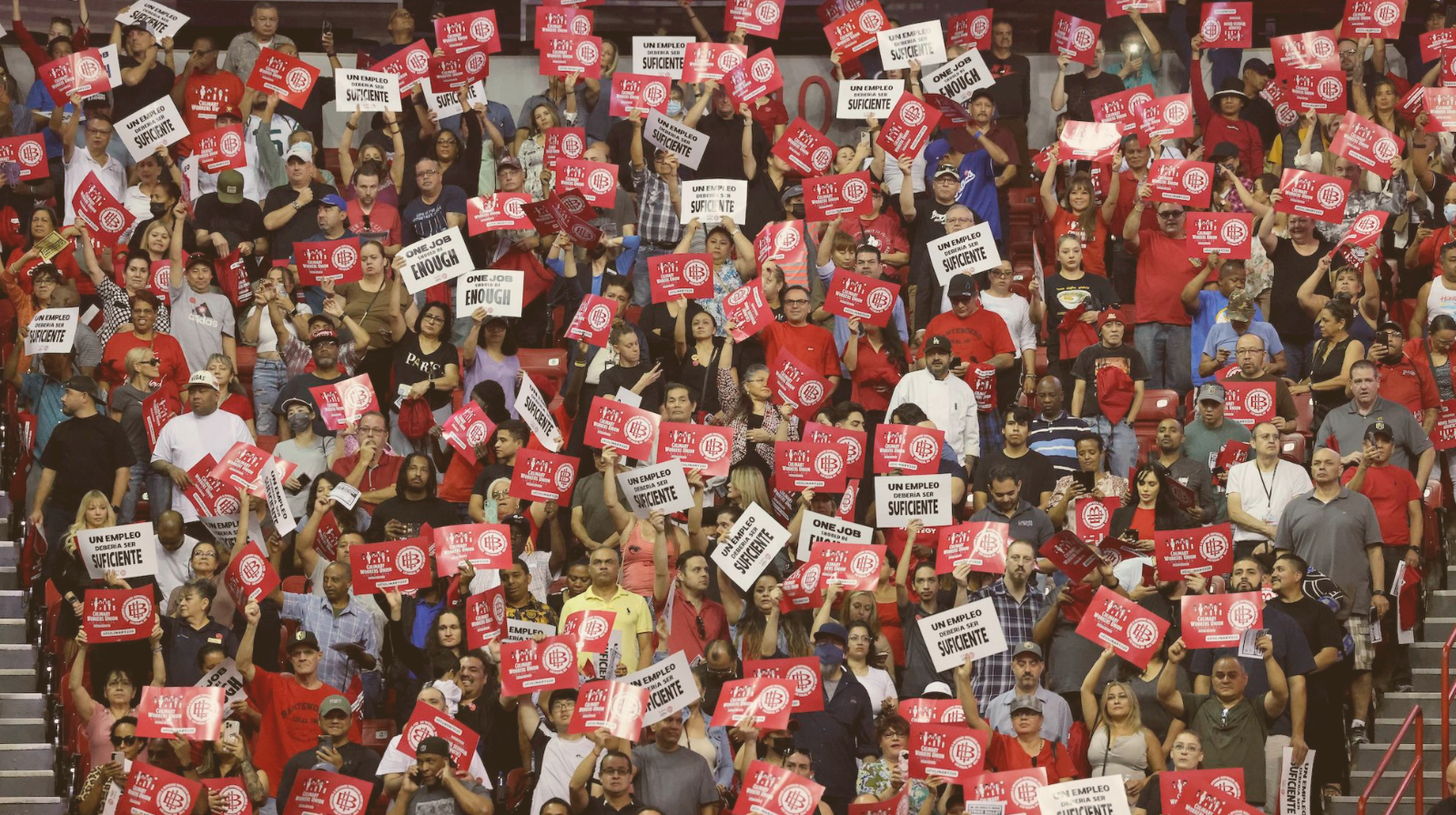
When the Venetian and Fontainebleau finally signed labor contracts this year, the Culinary Workers Union achieved something unprecedented: for the first time in its 90-year history, every major casino on the Las Vegas Strip is now unionized.
“The fight to unionize the Venetian has been one of the longest and most significant in Culinary Union’s 89-year history,” said Ted Pappageorge, the union’s Secretary-Treasurer. “From standing up to anti-union billionaire Sheldon Adelson in 1999, to winning the right at the U.S. Supreme Court to picket and protest on sidewalks in front of Las Vegas casinos, and now securing a historic first contract, workers never gave up.”
The contracts delivered a 32% wage increase over five years, bringing average compensation to $35 per hour. On paper, it’s a significant win. But the real story lives in what these numbers mean for workers navigating student debt, rising rents, and the precarity of service work. And now, just months after this historic achievement, workers face a new threat: what union leaders are calling “the Trump slump,” a sharp tourism decline driven by tariffs and immigration crackdowns that has left the Strip quieter than it’s been in years.
Yet this is precisely why the decades-long fight to unionize the Strip matters. The contracts workers secured, with their recall rights, healthcare guarantees, and seniority protections, weren’t designed for boom times. They were built to survive the downturns that inevitably come. Understanding how the Culinary Union achieved total Strip unionization reveals not just a labor victory, but a blueprint for worker power that endures when the economy turns hostile.

Targeting Concentrated Employers
Las Vegas has a structural advantage that makes organizing possible: a handful of corporations control the majority of Strip jobs. By 2005, MGM and Caesars alone operated 19 of the 29 Strip properties. Today, MGM operates 11 major Strip casinos, Caesars runs 8, and Wynn controls 2, creating what labor scholar Ruben Garcia describes as a dynamic similar to Detroit’s auto industry in its prime: concentrated employer power that, when organized effectively, gives unions enormous leverage.
The Culinary Union studied that reality and weaponized it. Rather than bargaining property by property, they moved as a unified Strip-wide force, coordinating contract expirations and strike threats across all three major operators simultaneously. Their strategy recognized a crucial reality of modern hospitality work: workers don’t stay in one building for decades anymore. Union organizers tracked members as they moved between properties, maintaining contact lists organized by department rather than employer. If MGM housekeepers prepared to strike, Caesars bartenders stood ready to follow. This portable solidarity (following workers across corporate boundaries) made it nearly impossible for management to isolate disputes or wait out pressure at individual properties.

Escalation by the Calendar
This campaign wasn’t built on picket signs alone. It was engineered around calendars and pressure points. The union synchronized its strike threats with Vegas’s most vulnerable moments: major conventions, holiday weekends, and the 2023 Las Vegas Grand Prix.
When 35-year-old bartender Maria Lopez joined the picket line two days before a massive tech convention, she understood the leverage: “They couldn’t afford bad press or empty bars. That’s when they finally sat down and talked.”
The 69-day strike at Virgin Hotels became a rallying symbol. It was the union’s first open-ended walkout in over two decades. Other unions showed up: stagehands, NFL players, performers. In a city built on spectacle, visibility became bargaining power.

Contracts That Deliver Stability
The gains were concrete, not performative. Workers secured a 10% raise in the first year alone, alongside reduced housekeeping quotas, enforceable staffing protections against automation, panic buttons for safety, and recall rights anchored in seniority.
For Paul Anthony, a 40-year Bellagio veteran, these provisions represented the difference between “just hanging on” and having “a career with longevity.” By translating contract language into lived impact (rent covered, medication paid for, weekends with family), the union built trust and commitment that extends beyond a single bargaining cycle.
Pappageorge emphasizes the union’s long view: “We’ve always viewed time differently. This isn’t just about the here and now, it’s about building a legacy of fairness and dignity for working families in Las Vegas.”

Rooted in the City
In a right-to-work state, staying strong requires more than workplace presence. The Culinary Union has woven itself into the fabric of Las Vegas life, running bilingual outreach, connecting wage fights to housing and transit issues, mobilizing voters on policies that shape the city’s future.
Diana Valles, the union’s president and a former housekeeper who has been a member for over 30 years, articulates the union’s vision clearly: “Still in Las Vegas, we have a standard, and that is the culinary standard, where workers have a contract.” That standard, she insists, applies to every hospitality worker in the city.
Labor scholar Ruben Garcia of UNLV draws parallels between the Strip’s concentrated employer power and Detroit’s auto industry in its prime: when a well-organized union roots itself deeply in the community, it can set the standard for an entire sector.

Why These Lessons Matter Beyond Vegas
The Las Vegas victory offers more than a celebratory headline. It provides a strategic blueprint for service-sector workers nationwide.
Concentrated leverage works. In industries where a few large employers dominate (airports, hospitals, stadiums, major retail chains), unions can maximize their influence by targeting these power centers rather than fragmenting efforts across dispersed workplaces.
Timing is tactical. Aligning contract fights or strike threats with peak economic or cultural moments creates leverage when employers are least able to absorb disruption. The 2023 Formula One race deadline wasn’t accidental. It was strategic.
Concrete wins build trust. Workers invest in unions when contracts deliver tangible, lasting improvements: fairer hours, stronger benefits, protections against automation, safeguards for seniority. Abstract promises don’t sustain movements. Material gains do.
Community roots matter. When unions embed themselves in the broader civic life of their communities (supporting voter engagement, partnering with local organizations, speaking to shared struggles), they become indispensable rather than optional.
The Culinary Workers Union’s success demonstrates how these elements function in concert: concentrated leverage, strategic timing, concrete contract victories, and deep community integration.
For service-sector campaigns across the country, these aren’t just lessons. They’re the architecture of durable worker power.

The Victory Meets the Reality
The historic 100% unionization of the Strip arrived at a precarious moment. Workers secured their strongest contracts ever. Then Las Vegas tourism entered what union leaders call “the Trump slump.”
Tourism dropped 11% in June 2025 compared to the previous year, with international visitors down 13%. Canadian tourism, once Nevada’s largest international market, has dried up from what Mayor Shelley Berkley describes as “a torrent to a drip.” Trump’s tariffs are partly to blame. So are immigration crackdowns that have scared away visitors from Mexico and Southern California’s Latino communities. Add to that broader economic uncertainty, and you have a perfect storm hitting Vegas tourism.
Valles is direct about the cause: “It is a Trump slump. That’s what it is, when you have the leader of this country telling the world that they’re not welcome here.“
Workers are already feeling the impact. Hours have been cut, some properties have announced layoffs, and tips have shrunk as foot traffic dwindles. The timing cuts both ways. After decades of struggle to unionize every major casino, workers finally won contracts guaranteeing job security, recall rights, and protections against arbitrary termination. Now the economy they depend on is beginning to falter.
But this is precisely why the union fought so hard for strong contracts. Pappageorge notes that Las Vegas workers “are familiar with the boom-and-bust nature” of the tourism industry. The difference now is that workers have the security and power to weather the downturn without losing everything they’ve built. Seniority-based recall rights mean workers can’t be permanently replaced during slow periods. Health care continues regardless of hours worked. The union becomes a stabilizing force in an inherently unstable industry.
The Las Vegas story offers a sobering lesson: winning strong contracts is just the beginning. Building worker power means preparing for the economic storms that inevitably follow. What workers won at the bargaining table matters. But the institutional strength they built to protect those gains matters more, especially when political and economic winds shift against them.
Reporting Note
This article is based on union contract summaries, public tourism and employment data, and contemporaneous reporting on Las Vegas hospitality labor campaigns and economic conditions. It draws on statements and interviews from Culinary Workers Union Local 226 leadership and members, academic analysis of concentrated employer power, and coverage from national and regional outlets documenting both the Strip-wide unionization victory and the subsequent downturn in tourism. The analysis situates the Culinary Union’s strategy within broader labor scholarship on coordinated bargaining, strike timing, and sectoral leverage, grounding all claims in publicly available data, on-the-record statements, and reported outcomes cited in the primary sources and further reading sections.
