

The story writes itself with an irony so thick you could fund it on the platform in question.
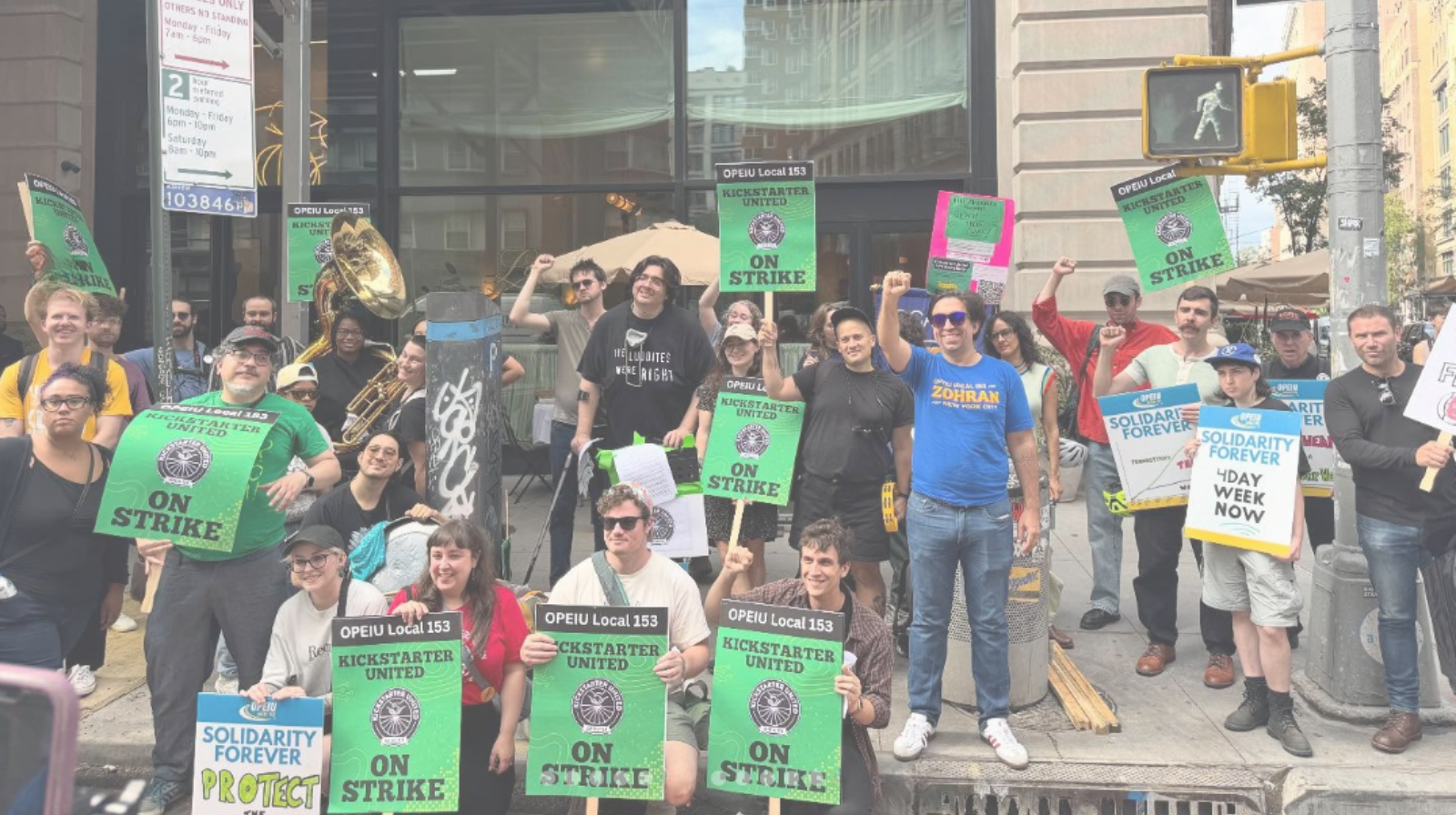
Kickstarter, the crowdfunding giant that has spent sixteen years helping independent creators bring their creative visions to life without interference from gatekeepers or profit-obsessed investors, is now locked in a bitter contract dispute with the very workers who make that mission possible. Since October 2nd, members of Kickstarter United have been on strike, fighting to preserve a four-day workweek and secure a minimum salary of $85,000 for the platform’s lowest-paid employees. The strike continues with no resolution in sight.
A company that transformed itself into a Public Benefit Corporation specifically to escape “the extractive, inhuman, and societally unsustainable framework that compels companies to optimize for profit over everything” now wants to unilaterally strip workers of their four-day workweek. At every turn, management has flatly rejected proposals for livable wages. The company that once proudly declared it would “consider the impact of its decisions on society, not only shareholders” fails to recognize that its own employees are part of that society.

The Breaking Point
The current crisis has been building since April, when Kickstarter United began negotiating its second contract with management after their first three-year agreement expired in July. The union, representing 59 workers including community support specialists, trust and safety analysts, marketing professionals, and software engineers, had two core demands: codify the 32-hour, four-day workweek that had been in place for over three years, and establish an $85,000 minimum salary.
Both demands are modest, reasonable, and grounded in the economic realities of working in New York City, where the union notes that $85,000 corresponds with what is considered low income. Management has refused both.
The four-day workweek shouldn’t be controversial. Kickstarter implemented it more than three years ago, and by all accounts, it worked. The platform continued to operate, employees reported better work-life balance and reduced burnout, and productivity held steady. Research published in Nature Human Behavior found that four-day workweeks resulted in improvements in burnout, job satisfaction, mental health, and physical health. Rather than codifying this success, management wants the option to revert to a five-day schedule “if a business need arises,” with “business need” defined entirely at their discretion. They want it to remain a privilege they can revoke at will.
According to union members, in March 2025, just as contract negotiations were beginning and knowing the four-day workweek was the union’s top priority, management abruptly shifted most employees to a five-day schedule without additional compensation. The subtext became text: we can take this away whenever we want.
Hillary Taverna, a senior product manager at Kickstarter, captured the heartbreak in a statement to union supporters: “After working across a few companies in the high-pressure, high-stress role that is product management, finding an opening at Kickstarter was like a breath of fresh air. Not only was the company a mission-driven public benefit corporation that helped fund creative ideas, but the role here offered groundbreaking benefits like the four-day workweek, which was and is still pretty revolutionary in the tech space. AND the role was unionized?! I was beyond excited to join Kickstarter, despite a significant pay cut from my prior role. Many of my coworkers and I joined Kickstarter for these exact reasons, and we are hoping beyond hope that leadership will live up to their promise of putting people above profit.”

The Promise and the Fine Print
Kickstarter’s status as a Public Benefit Corporation was supposed to mean something. When the company reincorporated in 2015, founder Perry Chen wrote that becoming a PBC would allow them to “unshackle from the extractive, inhuman, and societally unsustainable framework that compels companies to optimize for profit over everything.” The company’s charter made bold commitments: to “foster a supportive environment for employees to work on their own creative projects,” to “report on team and leadership demographics, executive and CEO pay ratios,” and to “build a diverse, inclusive, and equitable organization.”
At the time, these weren’t empty words. They were a promise that Kickstarter would be different. Workers would receive the same care and respect the company encouraged creators to show their backers. Mission and values would guide decisions, not profit margins.
The truth about Public Benefit Corporations: they guarantee workers zero enforceable protections. While the designation allows companies to “consider” social impact alongside shareholder value, it imposes no legal obligation to do right by employees. Because it’s a values statement, not a contract. And when push comes to shove, values can be remarkably flexible.
The gap between rhetoric and reality showed itself in 2019, when workers began organizing and management fired two prominent union organizers, Clarissa Redwine and Taylor Moore, while eliminating the position of a third, Travis Brace. The company claimed performance issues and business needs, but workers filed unfair labor practice charges in response. Even as Kickstarter positioned itself as a progressive workplace, it deployed the same union-busting playbook as any conventional corporation.

The Minimum Wage That Isn’t Minimum
Then there’s the pay issue. One in six union members currently makes less than $85,000, according to former organizer Clarissa Redwine. These are often the workers providing frontline support to Kickstarter’s community of creators and backers, the ones answering questions, resolving disputes, and maintaining the trust that makes the platform function.
Establishing an $85,000 minimum would cost the company an estimated $94,000 annually. “It’s a drop in the bucket compared to the total budget of the company,” Redwine noted. Kickstarter has claimed that “our staff is paid 10% above the industry average in tech,” but that rings hollow when some employees struggle to afford rent in one of the most expensive cities in the country.
An anonymous outreach manager told Homecrux: “These workers, essential to keeping creators supported, often live paycheck to paycheck. Management claims current pay is generous enough, but that’s hard to square when some colleagues can barely make ends meet.”
Brendan Griffith, president of the New York City Central Labor Council, spoke plainly: “Kickstarter workers deserve more than poverty wages in one of the most expensive cities in the world. They are fighting for a fair minimum salary that reflects New York’s reality, and management’s refusal to meet that demand is unacceptable.”

The Broader Stakes
The Kickstarter strike exposes what happens when mission-driven branding collides with workers who believed in it and now demand something concrete. The rhetoric about putting “people over profit”? Apparently it means “people, as long as they don’t ask for too much”.
As Margaret O’Mara, a professor of history at the University of Washington, explains in research on tech labor organizing, tech companies “recruited people by promising them that they would be working in a different kind of company, one that is, above all, transparent and pursuing a mission to make the world a better place.” Those employees are now “demanding that their employers make good on the promises they made,” says O’Mara.
“Tech-worker strikes are rare”, according to Emily Mazo, a PhD student at Columbia University who studies labor organizing in the industry. “It’s a sign of strength of the movement and the maturity of these tech worker unions that they are powerful enough to strike,” she said.
When Kickstarter became the first major U.S. tech company to unionize in 2020, they broke new ground. Now they’re on strike, and what management is fighting for turns out to be far more conventional: the unilateral right to take things away without negotiation and squeeze more hours from workers without compensation.

The Picket Line Grows
The strike has drawn substantial solidarity from across the tech labor movement. On the strike’s first day, nearly 50 union workers rallied outside venture capitalist Fred Wilson’s firm, Union Square Ventures, where Wilson serves as a Kickstarter board member and investor. Leaders from the New York Times Tech Guild and the Alphabet Workers Union joined the picket line, while Google union members organized a simultaneous solidarity rally in Seattle. New York State Assembly members Phara Souffrant Forrest and Emily Gallagher, sponsors of legislation establishing a four-day work week pilot program, also spoke at rallies in support of the union.
The workers have also organized an ongoing virtual picket line through their Instagram account, deploying the very community mobilization skills they use daily at Kickstarter. Participants have included NYC Comptroller Brad Lander, IL Congressional candidate Kat Abughazaleh, NY State Senator Jabari Brisport, Rutgers labor studies professor Eric Blanc, journalist Cory Doctorow, WorkFour Executive Director Vishal Reddy, Jozi Uebelhoer of Workers Strike Back, and labor journalists Kim Kelly and Hamilton Nolan. It’s a fitting strategy: workers whose job is building and engaging online communities using those same tools to fight for their own rights.
The breadth of support shows how much people wanted Kickstarter to be better than this. Especially given the story it told about itself.

The Platform That Forgot Its Own Story
Kickstarter didn’t always speak in corporate euphemisms: this platform emerged from lived experience with exclusion. Perry Chen, one of Kickstarter’s founders, wanted to bring DJs to New Orleans but couldn’t find funding through conventional channels. That frustration sparked the idea for a platform where creators could go directly to their communities, bypassing institutions that didn’t believe in their vision.
Kickstarter became successful precisely because it rejected the logic of traditional venture capital. It didn’t demand that projects be commercially viable or palatable to VCs. It trusted creators to know what they were doing and communities to support what they valued. That model helped bring more than 277,000 projects to life, from indie films to board games to journalism projects to innovative tech products.
Now that same platform is telling its own workers: trust us, we know what’s best for the business. The four-day workweek is great, but we need the flexibility to take it away if we decide it’s necessary. Your pay is fine, even if some of you struggle to afford rent. Just believe the process will work. Leadership will do right by you without any binding commitments.
That’s the dynamic Kickstarter was supposed to disrupt. Except now they’re the rigid gatekeepers stifling the workers who make the platform function.

When Empowerment Stops at the Office Door
Step back for a moment and consider what Kickstarter actually does. Every day, the platform helps creators dismissed by traditional institutions. Musicians whose work isn’t commercial enough. Filmmakers with stories that don’t fit Hollywood formulas. Writers covering topics mainstream media ignores.
Kickstarter tells these creators: your work has value. Your vision matters. You deserve to be compensated fairly for what you create. You shouldn’t have to compromise your art to satisfy investors or executives who don’t understand what you’re trying to do.
It’s a beautiful and life-affirming message. It’s also a message that apparently doesn’t apply to the workers inside Kickstarter’s own walls.
These people, who joined specifically because of the mission and values, are now being told their demands are unreasonable. Codifying a four-day workweek is too rigid. Asking for $85,000 minimum salary in New York City is too expensive. They should just trust management to do the right thing, even as management reserves the right to change conditions unilaterally.
Despite its ethos of empowering creators, Kickstarter insists workers submit to whatever terms management throws their way. The company rails against extractive capitalism while extracting more hours from employees without additional pay. And spending $94,000 annually to ensure its lowest-paid workers can afford rent? Even that proves too much for a Public Benefit Corporation that pledged to prioritize social impact over profit.
You can’t make this up. Or rather, you could, but it would be rejected as too on-the-nose.

What Happens Next
As of this writing, the strike continues with no resolution in sight. Kickstarter remains operational, though the absence of striking workers inevitably affects the platform’s ability to support creators and backers. Management continues to insist they’re “disappointed” by the strike while refusing to budge on the core issues. Workers continue to picket, holding rallies outside the offices of board members and investors.
The strike authorization vote was overwhelming: 85% of union members supported the action.
This strike will test whether mission-driven capitalism can stay the course or if it was always performance. Public Benefit Corporation status either means something enforceable or it’s just branding that helps with recruitment. Platforms can extend the independence they celebrate to their own workers, but will they? Kickstarter’s 59 unionized employees are forcing these questions for an entire industry.

The Test of Values
Kickstarter has spent years building a reputation as a different kind of company. Now comes the test. Not the soft kind that gets addressed in glossy benefit statements and carefully curated social media posts. The hard kind that reveals what a company actually prioritizes when workers demand their fair share.
So far, Kickstarter is failing spectacularly.
The company that helps creators fund their dreams now tells its workers that secure, sustainable work conditions are too expensive. Independence matters deeply, but only for the platform’s users, not its employees, whose working hours management insists on controlling. And the mission-driven organization that rejected “profit above all”? It won’t spend $94,000 annually to ensure its lowest-paid workers can afford rent.
When Kickstarter talks about empowering people to realize their creative visions, they don’t mean the people who work there.
And if a company that explicitly positioned itself as an alternative to extractive capitalism can’t treat its own workers fairly, what hope is there for every other organization making similar promises?
The workers on the picket line are fighting for an answer right now, without the benefit of a crowdfunding campaign or a community of backers to spread the word. Just their union, their solidarity, and the stubborn belief that they deserve better.
Every creator who has ever used Kickstarter to escape the system and fund their work directly needs to understand: without those workers, there is no platform.
Editor’s Note: This story has been updated to clarify that Clarissa Redwine is a former organizer. A previous version incorrectly identified her as a current organizer and bargaining committee member.
