

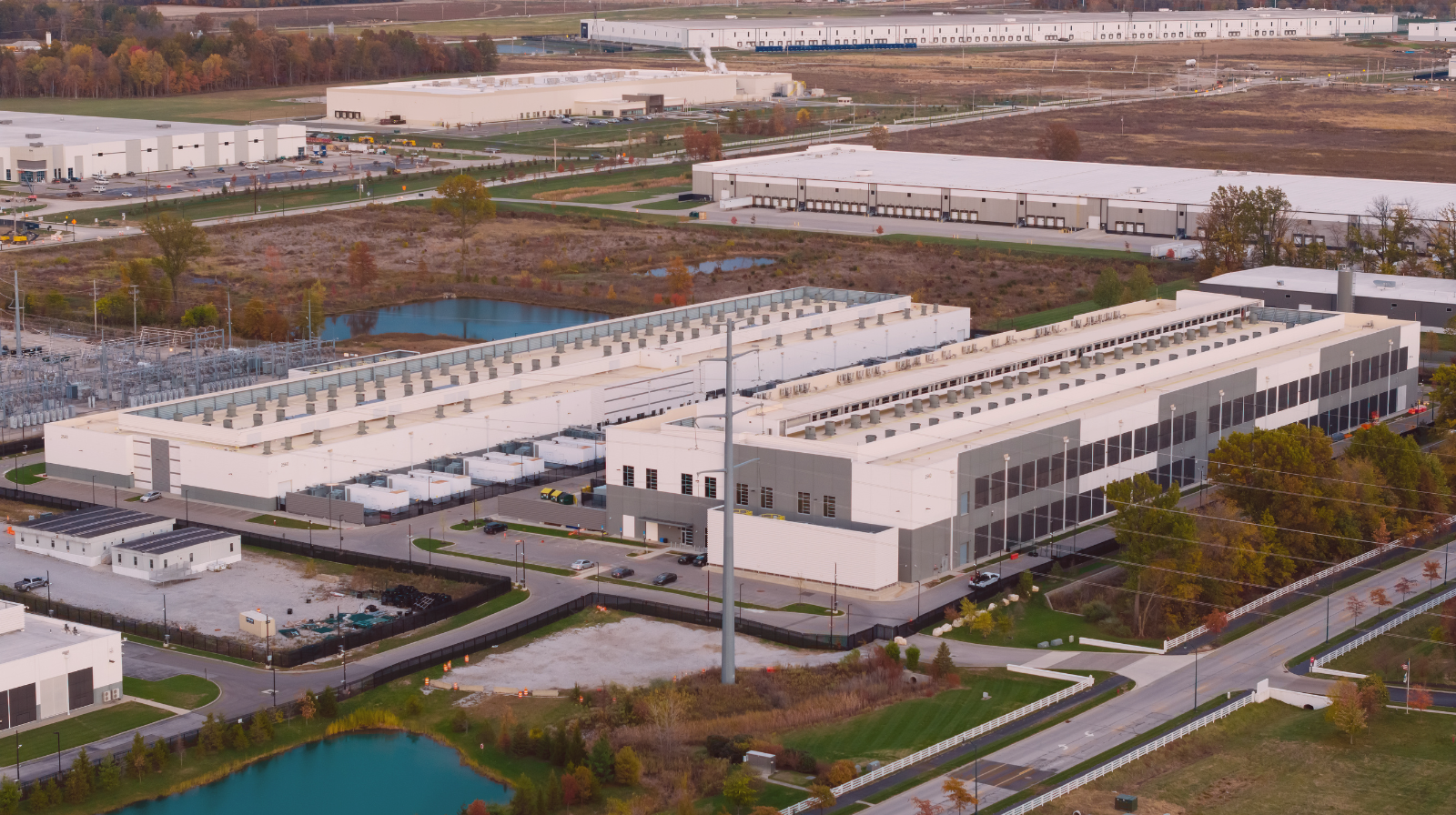
They arrive without ceremony. Low, windowless structures materialize on the outskirts of towns across America, set back from the road behind chain-link fencing and a veil of corporate anonymity. Nothing announces what happens inside. The parking lots remain sparse even at peak hours, and the surrounding streets carry none of the foot traffic that typically signals a workplace. The buildings hum with electrical current and cooled air, but the human presence is so faint it can feel like an afterthought.
These are data centers, and they are among the most consequential pieces of infrastructure in the 21st-century economy. The infrastructure of modern American life runs through these facilities, from financial transactions and cloud storage to streaming services and search engines people use without a second thought. As artificial intelligence entrenches itself further in healthcare, education, and human resources, the demand for the raw computing power these buildings house has become virtually insatiable. The International Energy Agency projects data center electricity demand could more than double by 2028, consuming up to 12 percent of total U.S. power, and U.S. construction spending on data centers alone reached $77.7 billion in 2025, a 190 percent year-over-year increase. Communities from Texas to Michigan to Virginia are being courted with promises of investment, tax revenue, and the vague shimmer of a “future-proof” economy. Communities from Texas to Michigan to Virginia are being courted with promises of investment, tax revenue, and the vague shimmer of a “future-proof” economy.
But the reality seldom acknowledged in pitch decks is that data centers employ almost no one.
A facility running 2 to 5 megawatts of power typically requires around 30 permanent workers. Outside Reno, a 1.1-million-square-foot Vantage Data Centers facility was projected to create just 73 permanent jobs over the next decade, even as more than 4,000 temporary construction positions cycled through the site. In Virginia, a 2024 legislative study arrived at a similar conclusion, finding that a typical 250,000-square-foot center may have approximately 50 full-time workers on staff. In short, this economic development model severs growth from employment entirely, regardless of how many people need the work.
The Boom That Doesn’t Hire
Across at least 32 states, communities have welcomed massive industrial facilities on the promise of lasting prosperity. The well-documented cycle typically begins when a tech company identifies a rural or semi-rural area with cheap land, abundant water, and cooperative local officials before breaking ground. Thousands of construction workers arrive in the area, local leaders hold ribbon-cutting ceremonies, and local businesses see an initial surge in new business. The long-term economic footprint has more in common with a bridge or a highway than a factory or long-standing employer, leaving communities with far fewer permanent positions than initial proposals suggested.
Even the Amazon fulfillment warehouse, for all its widely reported problems with working conditions and low pay, employs 1,000 to 1,500 permanent workers per facility. Data centers occupy comparable or even larger footprints, consume vastly more public resources, and employ a fraction of the people.
In Abilene, the first Stargate data center required 6,400 workers to build, yet estimates for its permanent workforce range from 100 to 1,000, with at least one projection landing as low as 357 full-time jobs. Google’s 500-acre, 500-megawatt campus in Kansas City follows a similar pattern, with 1,000 construction positions and just 200 permanent ones. Outside Reno, a 1.1-million-square-foot Vantage Data Centers facility was projected to create just 73 permanent jobs over the next decade, even as more than 4,000 temporary construction positions cycled through the site. For comparison, even the Amazon fulfillment warehouse, for all its widely reported problems with working conditions and low pay, employs 1,000 to 1,500 permanent workers per facility. At the macro level, the U.S. Census Bureau reported that data center employment grew 60 percent between 2016 and 2023, but over 40 percent of those jobs are concentrated in just five states, clustered overwhelmingly in a handful of urban counties. For the vast majority of communities being pitched data center projects, the employment benefit is marginal at best.
For communities housing them, the disconnect between these capital-intensive investments and their minimal labor footprint has generated substantial fiscal consequences. When the subsidies behind these deals are tallied, the cost to local governments is more than $2 million per permanent job, a ratio so lopsided that policy experts recommended capping public subsidies at $50,000 per job and called on states to reconsider whether these incentive programs should continue.

Industrial Growth Minus Employment
Landmark legislation like the National Labor Relations Act from FDR’s New Deal enshrined the principle that industrial growth and worker power were inseparable. At the local level, governments reinforced that expectation for decades by conditioning tax incentives and land deals on job creation targets, tripling the size of those programs between 1990 and 2015. Data centers have severed that link entirely, leaving communities to surrender precious resources while the employment side of the exchange evaporates.
“Industrial development is increasingly being detached from employment altogether.”
In Abilene, Texas, what has become one of the most notorious examples of data center devastation began when the Stargate project brought 6,000 out-of-state construction workers into a city of 100,000 that was already short 5,600 housing units before the first crew arrived. Landlords began rejecting Housing Authority vouchers from elderly and disabled tenants in favor of data center workers who could pay more, leaving the agency to direct its clients toward housing in other counties where they would have no access to the medical care, disability services, and support networks they had relied on for years. Rosten Callarman, the executive director of Abilene Habitat for Humanity, said that for the first time, entire families were showing up at the city’s homeless encampments because their landlords had doubled the rent, while some of the construction workers building the facility resorted to sleeping in their trucks because there was nowhere else to go. When construction winds down, most of those workers will leave, but the displaced families, the collapsed housing market, and a permanent workforce that may number in the low hundreds will be what Abilene is left with after absorbing a $500 billion project that was never designed to employ the people who live there.
With localities continuing to sign off on these deals, data centers are establishing the terms for every capital-heavy, labor-light industry that follows. Battery plants, autonomous vehicle depots, and AI-driven manufacturing facilities will all be emboldened to replicate this same model of massive public investment and negligible employment. By continuing to subsidize this wasteful precedent with billions in tax incentives and discounted utilities, governments at every level are normalizing the dangerous idea that industrial development no longer needs to include workers.
When There’s No Workforce to Organize
The problem is that this organizing has no institutional home. Traditional unions bargain over wages, benefits, and conditions inside facilities with workforces large enough to sustain collective action. But a data center with 50 permanent employees offers nothing for that model to latch onto. Major labor institutions have been slow to reckon with this new terrain. While the AFL-CIO released a “Workers First Initiative on AI” in 2025, it does not address data center development or its impact on communities, and the federation has yet to stake out a position on an industry that is rapidly reshaping how Americans relate to industrial development. Building trades unions, which profit from lucrative data center construction contracts, have reason to support these projects even when the permanent job numbers are negligible. At the federal level, the NLRB is recovering from a prolonged period of paralysis after losing its quorum and is expected to undergo a drastic ideological shift toward employer-friendly policies and weakened worker protections. Even environmental groups, which have engaged aggressively on the water and energy questions, rarely frame their opposition in labor terms.
In the absence of any organized response, community groups have stepped into the role of opposition. Instead of bargaining for better conditions inside a facility, these groups are challenging whether a facility should exist at all without meeting basic obligations to the people who live around it. They are organizing around resource extraction rather than workplace conditions, arguing that development should not be permitted to consume a community’s water, electricity, and tax base while offering virtually no employment opportunities or community betterment in return.
“Data centers are establishing a model of growth that no longer requires workers.”
According to Data Center Watch, resistance surged 125 percent in the second quarter of 2025 alone, with an estimated $98 billion in projects blocked or delayed across nearly 200 community groups in more than two dozen states. In Tucson, residents organized so effectively against a project that would have consumed millions of gallons of desert drinking water that the city council unanimously cut off discussions with the developer. In Jerome Township, Ohio, residents imposed a moratorium after learning that two massive Amazon facilities on their land would pay no property taxes for years. Legislators are beginning to follow their lead, with Illinois introducing the POWER Act to require data centers to fund their own grid infrastructure and Governor Pritzker suspending state tax incentives for new developments for two years.
The end result is a sprawling, decentralized national campaign with no coordinating infrastructure or shared bargaining strategy.

New Terms for the Capital-Heavy Economy
The financial rationale behind these projects is shaky even by the industry’s own admission. The hedge fund manager Harris Kupperman, writing in late 2025, observed that insiders across the data center industry were baffled by the math behind these facilities and unable to explain how these investments would generate returns. Essentially, the public is expected to gamble its future on a model whose own investors are unsure the numbers work.
If communities are going to keep surrendering land, water, electricity, and tax revenue for industrial facilities that employ almost no one, new terms must be established. Should data centers be required to fund local job training programs and contribute to community employment funds? Should they pay living wage surcharges proportional to the gap between their capital investment and their labor footprint? These are fragments of a policy framework that doesn’t yet exist but is urgently needed, and the labor movement is ideally positioned to help build it. The tools of collective bargaining, coalition strategy, and political leverage that organizers have spent a century developing are exactly what these 200 community groups need. Up to this point, that partnership has not come to be, but every new data center deal approved on the current terms makes it harder to demand better ones.
Reporting Note
This article draws on contemporaneous reporting, government data, policy research, and industry analysis on the rapid expansion of U.S. data centers and their economic impacts. It situates the development boom within broader research on industrial policy, labor markets, and public subsidy programs.
