

The narrative engulfing labor coverage right now is destruction. In January, Donald Trump fired NLRB board member Gwynne Wilcox, the first time in history a president has removed a board member before their term expired. The move left the agency without the quorum it needs to issue decisions for nearly a year, and a D.C. Circuit Court of Appeals ruling in December has effectively blessed the gutting. Though the Senate restored the Board’s quorum on December 18 by confirming two Republican nominees, the agency is now stacked with a 2-1 management-friendly majority and a new General Counsel poised to dismantle Biden-era worker protections. Union density has slipped to 9.9 percent, another record low, even as public approval of unions hovers near 70 percent and union election petitions have more than doubled since 2021.
But excluded workers never had the luxury of federal protection in the first place. So over the past several decades they built their own infrastructure for organizing and winning power. Farmworkers and domestic workers were cut out of the 1935 National Labor Relations Act through a compromise with Southern segregationists who refused to extend collective bargaining rights to Black workers in agricultural and household jobs. Ninety years later, those exclusions persist. Millions more have been pushed outside federal labor law through classification: gig workers are routinely designated independent contractors, which strips them of the right to organize under the NLRA entirely.
Born from that exclusion and accelerated by political turmoil, an alternative ecosystem of worker power emerged that doesn’t rely on NLRB elections or federal recognition. It operates under the assumption the government won’t provide sufficient protections. And as the traditional labor movement confronts an administration openly hostile to its existence, these models offer an urgent proof of concept for building power outside the state.
What follows is a map of that landscape. Over the coming months, LaborWise will report on each of these models in greater depth, examining how they work, who they protect, and where there is room for improvement. None of these alternatives can replace a functional NLRB, which provides a universal framework for union recognition, unfair labor practice enforcement, and collective bargaining rights across industries. But workers need options should the agency be dismantled entirely, and no single model fits every sector or region. For workers who cannot afford to wait for Washington, these alternatives offer a way forward and a foundation to build from.

Worker-Driven Social Responsibility
Unlike the corporate social responsibility programs and fair trade labels that proliferated in the 1990s, worker-driven social responsibility puts workers at the center of defining standards and enforcing compliance. The Fair Food Program is probably the most proven model for protecting workers entirely outside the NLRB framework. Launched in 2011 by the Coalition of Immokalee Workers, the program targets supply chains rather than workplaces, with farmworkers building binding agreements with corporations at the top of the food system like Taco Bell, McDonald’s, Walmart, and Whole Foods. Those retailers commit to purchasing only from growers who comply with a worker-authored code of conduct covering wages, working conditions, and zero tolerance for forced labor and sexual assault.
Growers who violate the code lose access to major buyers, a market-based enforcement mechanism that has proven far more effective than government regulation. The program has also adapted to new threats: in 2021, it implemented what the Washington Post called the nation’s strongest workplace heat protections, including mandatory rest breaks every two hours, shade, water, electrolytes, and protection from retaliation for workers showing heat stress symptoms. Since 2011, the program has delivered over $50 million in bonuses directly to farmworkers and expanded to 21 states, Chile, and South Africa, earning recognition from the USDA as the “Platinum” standard of human rights protection in American agriculture.
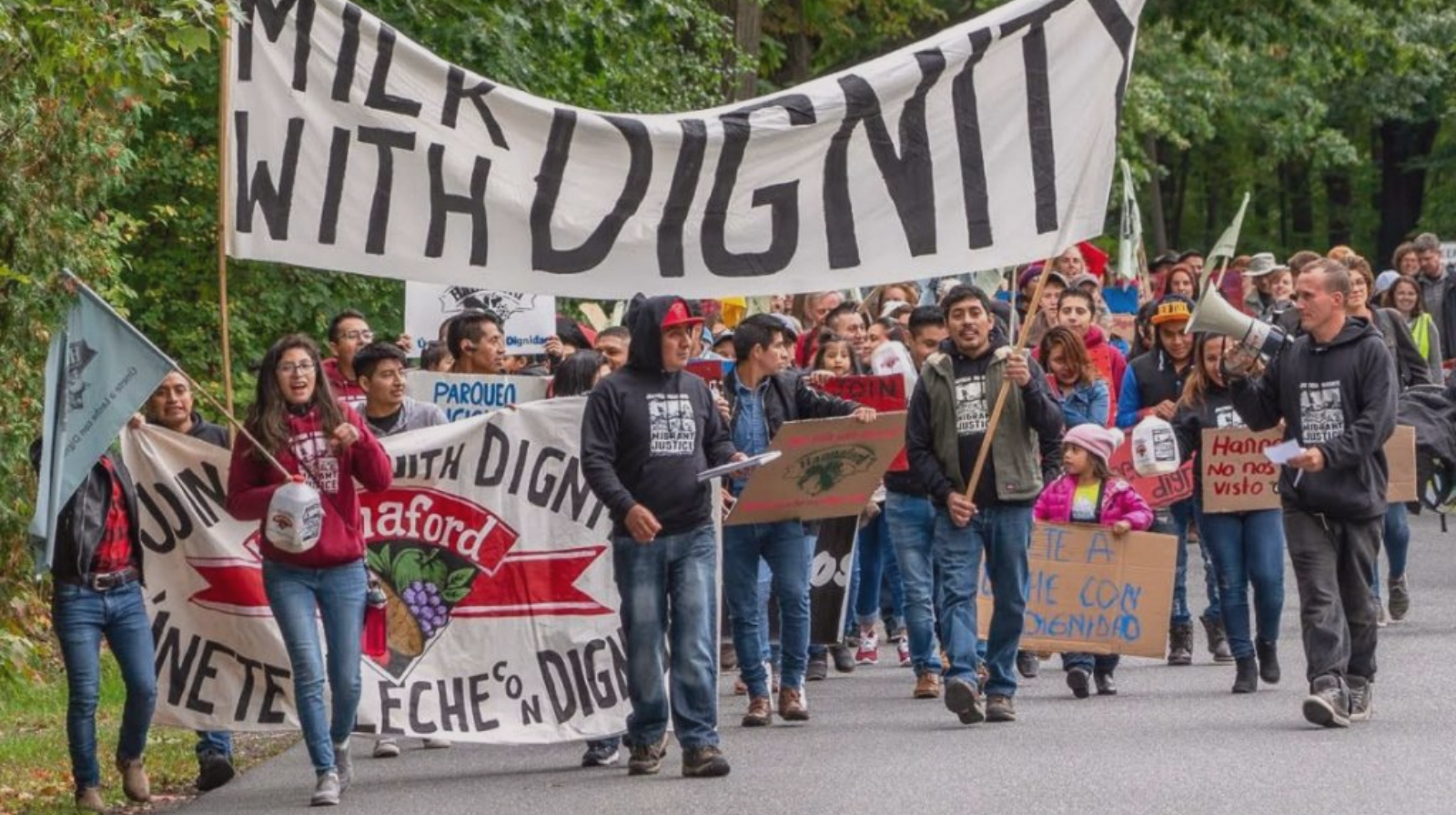
In Vermont, Migrant Justice adapted the framework for dairy workers, building the Milk with Dignity program that now covers over 50 farms and 250 workers with Ben & Jerry’s as the anchor buyer. Globally, the International Accord protects over 2.5 million garment workers in Bangladesh and Pakistan through binding agreements with apparel brands. All of these programs operate under the umbrella of the Worker-driven Social Responsibility Network, founded in 2015 to coordinate expansion.

Volunteer-Led Workplace Organizing
If Worker-driven Social Responsibility reimagines how labor standards are enforced, EWOC reimagines the organizing model itself. Traditional union campaigns are expensive, typically requiring one paid staffer for every 100 workers targeted. Most labor organizations simply lack the resources to support workers at small employers or in fragmented industries, and workers who call looking for help are often turned away. As one EWOC organizer explained, “Most unions will help workers get from steps 51-100 in organizing a union. We help get workers from steps 1-50.”
EWOC emerged in March 2020, when the Bernie Sanders campaign began receiving calls from workers with nowhere else to go. What started as an ad-hoc Google form became a joint project of Democratic Socialists of America and the United Electrical Workers, with trained volunteer organizers providing one-on-one support to workers trying to build power at their jobs.
As an all-volunteer operation, EWOC has been involved in over 300 campaigns and has passed off approximately 200 to unions for formal representation, supporting workers at board game cafes in Chicago, Chipotle locations in Kansas, and the University of Maryland Medical Center, where residents and fellows won 628 to 19 in Maryland’s first-ever residency unionization. But EWOC also supports workers who take collective action without seeking formal recognition, a form of solidarity unionism built on the premise that “two workers working together to collectively better their conditions is already acting like a union.” The model posits that scale matters more than deploying professionals to win every campaign.

Sectoral Bargaining Without the NLRB
In most wealthy democracies, wages and working conditions are negotiated by sector rather than workplace by workplace, a system that research links to higher union membership, lower inequality, and broader collective bargaining coverage. The United States has never operated this way because the NLRA channels organizing and bargaining to the level of the individual enterprise, establishing a single worksite as the default unit for negotiation. But something resembling sectoral bargaining has begun to emerge at the state level, with California leading the experiment. The approach has American precedent: the original Fair Labor Standards Act created tripartite industry committees that set minimum wages sector-by-sector for 21 million workers before the system was abandoned in 1949.
The California Fast Food Council, created by AB 1228, is the nation’s first for the industry, empowering workers and employers to negotiate wages and working conditions across a sector that has long resisted traditional unionization. When the law took effect in April 2024, the minimum wage for the state’s 500,000 fast food workers rose to $20 per hour, a $4 increase that researchers at Harvard’s Shift Project have called the largest instantaneous minimum wage increase in recent U.S. history. Going forward, the council can raise wages annually and propose new health and safety standards, a permanent seat at the table for workers in an industry that has spent decades fending off traditional unionization.
California is no longer alone. Six states have now created industry standards boards, and the sectors they cover reveal where traditional organizing has struggled most: fast food in California, nursing homes in Michigan and Minnesota, home care in Nevada and Colorado, and agriculture in New York. Though federal preemption limits these boards to wage-setting and advisory roles rather than binding multi-employer contracts, they still operate in complete independence from the NLRB, setting standards through government-convened negotiation rather than the enterprise-level collective bargaining that has defined American labor law since 1935.

Worker Centers and Excluded Workers
For the millions of workers the NLRA explicitly excludes, worker centers have long been the only game in town. The farmworkers and domestic workers cut out of the 1935 law, the day laborers classified as independent contractors, have no right to NLRB elections, no unfair labor practice protections, no legal path to collective bargaining. Worker centers grew out of that void, organizing and advocating for workers the law abandoned.
As of 2021, there were at least 246 active worker centers in the United States, up from just 5 in 1992. Unlike unions, they are not regulated as labor organizations under the NLRA, which means they can operate without the law’s election rules and reporting requirements. They organize workers who cannot legally unionize, and increasingly, workers who could but face insurmountable employer resistance.
Locked out of federal law, the major national networks built their own path to power, winning state and local protections the NLRA never provided. The National Domestic Workers Alliance, founded in 2007, has won Domestic Workers Bills of Rights in 12 states, two cities, and the District of Columbia. These laws extend basic protections to nannies, housecleaners, and home care workers including minimum wage coverage, overtime pay, meal breaks, and protection from retaliation. In January 2024, New Jersey became the latest state to pass such legislation, covering the state’s 50,000 domestic workers.
In recent years, worker centers have also forged partnerships with traditional unions, including joint organizing between NDLON affiliates and the Laborers union in residential construction and between the L.A. Black Worker Center and IBEW to increase Black representation on public infrastructure projects.
The National Day Laborer Organizing Network organizes construction and landscaping workers who gather each morning at hiring sites, waiting for contractors to offer a day’s work. Restaurant Opportunities Centers United has built power among restaurant workers through wage theft campaigns and industry exposés. United for Respect has taken on retail giants Walmart and Amazon. All of them operate entirely outside the federal labor law framework.

Labor Standards Through Public Procurement
When transit agencies award contracts worth billions of dollars to manufacture buses and rail cars, job quality seldom factors into the decision. Jobs to Move America has spent a decade trying to change that. The organization developed the U.S. Employment Plan, a federally approved policy tool that alters the bidding process itself. Instead of competing on price alone, manufacturers must disclose the number of jobs a contract will create, where those jobs will be located, what they will pay, and how the company plans to recruit and train workers from disadvantaged communities. Transit authorities can then weigh those commitments when selecting a winner.
The framework has reshaped manufacturing decisions across the country. When LA Metro adopted it, Japanese manufacturer Kinkisharyo won a rail car contract and moved its U.S. headquarters to Los Angeles County, creating over 550 direct jobs and new production facilities. When the Chicago Transit Authority awarded a $1.3 billion rail car contract to CRRC, the deal included a community benefits agreement requiring recruitment and training of low-income workers, returning citizens, and veterans. Amtrak used the plan to secure commitments for 400 jobs in upstate New York. JMA estimates that the $5.4 billion spent annually on bus and rail car purchases could create 530,000 American manufacturing jobs over the next decade if states and cities applied labor standards to procurement.

Membership-Based Unions Outside Enterprise Bargaining
North Carolina, South Carolina, Georgia, and Alabama all have right-to-work laws and union membership rates below the national average. The Carolinas sit at the very bottom of the national rankings, with union density hovering around 2.5 percent. The region’s hostility to organized labor traces back to explicitly white supremacist campaigns launched after the New Deal to block multiracial union organizing and maintain Jim Crow labor relations. For decades, the mainstream labor movement largely abandoned the region.
The Union of Southern Service Workers looks like a union on paper but operates free of the usual constraints. Rather than organizing workers at a single employer and petitioning the NLRB for a recognition election, USSW has declared itself a union by the simplest possible definition: workers coming together to use their strength in numbers. Members sign cards, pay dues, and belong to the organization regardless of where they work. A McDonald’s worker who moves to Dollar General remains a USSW member. A home care aide who picks up a second job in retail is still covered. The model is designed for an economy of high turnover and unstable scheduling, where workers cycle through employers too quickly to sustain a traditional organizing campaign at any single workplace.
In 2022, more than 100 workers signed membership cards across fast food, retail, warehouse, and care jobs throughout the South. The model echoes pre-Wagner Act unionism, when workers organized by trade and geography rather than by individual employer. For Southern service workers, the formal right to an NLRB election matters less than the power they’re building outside it.
Reporting Note
This article draws on reporting, public records, and research from worker organizations, federal and state agencies, academic institutions, and labor policy outlets, including the Bureau of Labor Statistics, the National Labor Relations Board, the California Department of Industrial Relations, the Harvard Center for Labor and a Just Economy, the Harvard Shift Project, the Economic Policy Institute, and organizations such as the Coalition of Immokalee Workers, the National Domestic Workers Alliance, Jobs to Move America, and the National Day Laborer Organizing Network, alongside coverage from outlets including ProPublica, NPR, The Nation, OnLabor, Labor Notes, and The American Prospect.
