

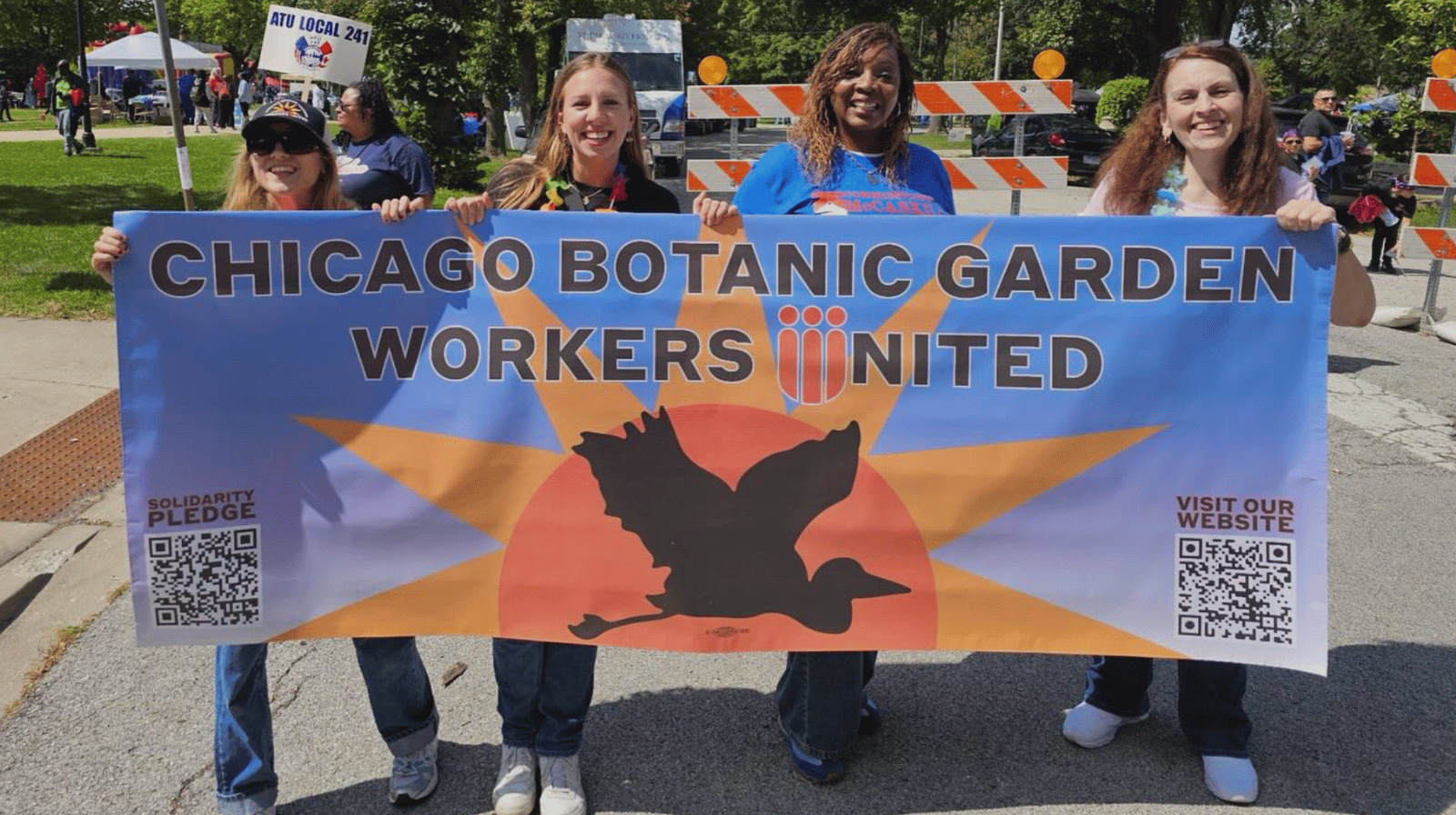
On an October afternoon, Kai Shin stood before the Forest Preserve District of Cook County’s board of commissioners and did something that should have been unremarkable in a democracy: he spoke publicly about his workplace. Shin, a facilities assistant with the Chicago Botanic Garden’s Windy City Harvest program, raised concerns about working conditions and a wave of terminations that had unsettled his colleagues over the summer.
One week later, he was fired.
The Garden maintains that the termination had nothing to do with his public comments, citing instead an issue with how Shin had requested paid time off. Shin filed an unfair labor practice charge with the National Labor Relations Board, alleging retaliation. The incident has become a flashpoint in what is now a full-scale union organizing campaign at one of America’s most celebrated botanical institutions, drawing unprecedented intervention from Cook County elected officials.
Unlike most cultural nonprofits, which operate on privately owned land with independent governance, the Chicago Botanic Garden sits on 385 acres of Forest Preserve District property. The county provides roughly $9 million annually to support operations, accounting for about one-third of the Garden’s budget. Its million-plus annual visitors likely have no idea they’re on public land managed by the Chicago Horticultural Society. This arrangement has made the Garden a regional treasure, but it also means its treatment of workers carries public implications most cultural institutions don’t face. When a quasi-public entity is accused of retaliating against a worker for participating in a public government meeting, the dispute stops being merely an internal HR matter and becomes a matter of public concern.

Seeds of Conflict in the Garden’s Showcase Program
At Windy City Harvest’s Farm on Ogden, tilapia and koi swim in tanks beneath grow lights, their waste feeding crops in an aquaponics greenhouse. Nearby, beehives produce local honey. The program is one of the Garden’s flagship initiatives, employing 30 to 40 justice-involved individuals and veterans each year in full-time, paid transitional jobs, training them for careers in food systems. Darius Jones, a program graduate who now manages the McCormick Place rooftop garden, told the Chicago Tribune the experience was “a complete life changer. I went from not working at all, not ever having a job, to managing over 60,000 pounds of produce a year.”
But between May and October of this year, management terminated seven people without warning. Five of them were current or former participants in the workforce development program itself. In the union’s newsletter, workers questioned how a workforce development mission squares with firing your own trainees without warning.
In August, after three terminations occurred in rapid succession, Shin spoke out. He sent an email to management voicing ethical concerns, copying several colleagues. Later that week, his manager threatened him, telling him he “should be terrified.”
These events motivated Shin to testify at the October 21st county board meeting where Resolution 25-0377, “Supporting the Chicago Botanic Garden Workers,” passed unanimously. One week later, management fired him. During the conversation, they made clear it was “for being a guest speaker” the previous week.
“I believe that growing a beautiful garden requires nurturing every member of the ecosystem,” Shin said at the hearing, “from the smallest pollinator up to the gardener spending their days in the heat and haze.”

The People Behind the Plants Speak Out
The organizing campaign, supported by the Chicago and Midwest Regional Joint Board of Workers United, went public last summer and has grown through the fall and into winter. It spans horticulturists, landscape crews, educators, visitor services staff, and Windy City Harvest employees. More than 400 workers would potentially be covered by a union.
Their grievances echo those heard across Chicago’s cultural sector, where workers at the Art Institute, Field Museum, and Shedd Aquarium have organized over the past four years. Botanic Garden employees describe wages that have not kept pace with Chicago’s cost of living, limited pathways for advancement, and seasonal instability.
Lorilin Meyer, an assistant horticulturist, told the Chicago Sun-Times that she received a raise of just 19 cents following a promotion. CEO Jean Franczyk, by contrast, earns $474,498 annually. “I think that workers in the country are feeling the pinch and feeling unheard,” Meyer said. “To have this huge gap between people who have and people who have less is extremely frustrating.”
Angellica Kucinski, an assistant cultivator, loses her job and health insurance for at least 13 weeks every year. “My monthly income on unemployment is decreased by over 50 percent,” she said. “It barely provides me with enough money to pay my bills. And that doesn’t include groceries. That doesn’t include gas.” A union contract, she said, would bring her “a sense of security, knowing my job is going to be there for me in the spring and knowing that I will be provided a living wage.”
Bailey Uttich, an aquaponics coordinator at Windy City Harvest’s North Lawndale location, told The Record she loves her job but believes the management culture undermines the collaborative environment the program is supposed to foster. “I want to see the organization practice what it preaches in relation to working conditions,” she explained.
For many on staff, these concerns gain particular resonance because of what the Garden represents publicly. Windy City Harvest, the urban agriculture initiative at the center of the Shin controversy, exists specifically to help people marginalized by the criminal justice system and food insecurity build sustainable careers. Its marketing emphasizes transformative impact, touting an approximately 80 percent placement rate into permanent food-systems employment. When workers in that very program allege they have been silenced or dismissed for raising concerns, the dissonance becomes glaringly apparent.

The County Crosses the Garden Gate
It’s rare for government officials to insert themselves into nascent union campaigns at nonprofits, making what happened in Cook County extraordinary.
After Shin’s testimony, the Forest Preserve District’s board of commissioners passed a resolution in October urging Garden leadership to accept “card check neutrality,” a process in which an employer agrees to remain neutral while workers decide whether to organize, recognizing the union if a majority sign authorization cards verified by a neutral third party. The resolution was sponsored by Commissioner Alma Anaya, who sits on the board’s Chicago Botanic Garden Committee.
On November 18, the intervention intensified when Cook County Board President Toni Preckwinkle, who also leads the Forest Preserve District, held a press conference publicly supporting the workers’ right to organize. Standing alongside union representatives and Garden employees, she celebrated the 400+ workers who “make the visitor experience extraordinary” and affirmed that they deserve “respect and the right to organize.”
“Historically in Chicago and in Cook County, we have been an area that respects our workers,” Commissioner Anaya said at the event. “We fight for our workers and any type of wins that we have had for worker rights have really started here.”
For the Garden, there is no easy way to dismiss any of this. It cannot simply ignore its landlord, nor can it easily brush aside the fact that county officials have publicly sided with its workforce in a labor dispute. For an institution that has cultivated a reputation as a leader in environmental justice and community wellbeing, having elected officials question whether it treats its own employees justly creates a tension that will be difficult to resolve through public statements alone.
Preckwinkle went further, noting that the resolution applies not just to the Botanic Garden but to workers at “Cook County museums, nonprofits and cultural organizations who are courageously raising their voices and asking for a seat at the table.”

What Management Says and Doesn’t Say
On the question of union recognition procedures, management has drawn a hard line. In a letter responding to the county resolution, President and CEO Jean Franczyk, who will retire in March 2026, disputed the retaliation allegations categorically. “The Garden would never terminate an employee for supporting or not supporting union activity,” she wrote. “Any employment decisions we made are made based on objective, job-related factors, not an employee’s perceived union view.”
On the question of union recognition procedures, management has taken a firm position. The Garden opposes card check neutrality and instead supports a secret-ballot election supervised by the National Labor Relations Board.”Federal labor law establishes a process for employees to exercise their rights by making their choice for or against representation in a secret ballot election,” Franczyk wrote. “Embracing ‘card check neutrality’ would eliminate the opportunity for employees to vote in a secret election.”
Garden spokesperson Julie McCaffrey expanded on this reasoning, arguing that neutrality would amount to “an abdication of our staff-developed value of open, direct communication between employees and leadership.” She noted that many employees have expressed opposition to unionization directly to management, and that if workers ultimately voted to unionize through a secret ballot, the Garden would “honor that choice and bargain in good faith.”
The disagreement over card check versus secret ballot is a standard fault line in American labor disputes, with management typically preferring elections that allow time for counter-campaigning and workers often preferring card check as a faster path to recognition that minimizes employer influence. Union organizer Matt Muchowski of CMRJB Workers United called the Garden’s election request a “delay tactic so that they can continue to intimidate workers,” while Garden leadership frames it as protecting individual workers’ right to a private vote.
What remains unresolved is whether the Garden’s decision to fire Kai Shin one week after his public testimony constitutes retaliation under federal labor law. The NLRB charge, filed in late August and still open, will ultimately determine the legal answer. But for workers watching from inside the Garden, the outcome will signal whether speaking up carries consequences.

Whether the Garden Will Tend Its Own
The Chicago Botanic Garden teaches more than one million visitors each year about stewardship, care, and ecological responsibility. Its scientists work to prevent plant extinctions, its urban agriculture programs help justice-involved Chicagoans build careers, and its grounds offer visitors a respite of natural beauty in an urban landscape.
The workers who make all of this possible are now asking whether an institution built on those values can model them internally. Can one of the country’s most celebrated environmental institutions sustain the people who sustain its mission?
The months ahead will bring an NLRB investigation, more authorization cards, and continued scrutiny from county officials. Eventually, the Garden’s workforce will make a choice about their future.
The Garden has spent half a century cultivating natural ecosystems. Whether it will recognize the need to tend to the human one within its own walls is another matter.
