

Before tourists arrive at Telluride Ski Resort each morning, patrollers have already spent hours in the dark, hiking ridgelines to trigger controlled avalanches across the San Juan Mountains. Once the mountain opens, they shift from explosives work to emergency response: rappelling down cliff faces to reach injured skiers, guiding rescue helicopters through storms, and treating trauma in conditions where minutes determine outcomes.
On November 18, every member of the Telluride Professional Ski Patrol Association (TPSPA), represented by CWA Local 7781 and United Mountain Workers, voted to authorize a strike. The 84-0 decision came after eight months of negotiations over a contract that expired in late August. Teleski, the company that owns the resort, has offered patrollers a 2.5 percent raise. The union is asking for approximately 30 percent.
Final negotiations are scheduled for December 5 and 6. The resort opens December 6.

The Economics of Mountain Work
Entry-level patrollers start between $21 and $25 per hour. After years mastering terrain that includes the 13,300-foot Palmyra Peak, accessible only by a 90-minute hike from the nearest lift, veterans might reach $30. One-bedroom apartments in Telluride rent for $4,000 to $5,000 monthly. San Miguel County calculates that seasonal workers need $37.37 per hour to live here.
“In this town, you can get a dishwashing job for $35,” union president Graham Hoffman has said, noting that other jobs pay more than patrol work while carrying less risk.
However, Teleski owns and manages employee housing for roughly two-thirds of its 1,800 peak-season workers. The remaining third navigate the private rental market or commute from surrounding towns. In fact, census data shows Telluride’s population increases 73 percent daily from commuting workers. Meanwhile, nearly half of housing units sit vacant as second homes.
Still, patrollers who cannot secure spots in Teleski’s limited employee housing face 40-minute commutes from Norwood or Ridgway, where even homes in bedroom communities exceed $300,000. Those who try to stay local face constant displacement. In one case, a resort worker moved four times in eight months before his last rental sold for $3 million cash.
Jackie Kearney framed what the union is asking for: “We’re often risking our lives for the benefit of the company, and we believe it’s more than fair to ask for an hourly wage that reflects institutional knowledge and allows patrollers to pay rent, buy groceries and save a little each month so if they do get hurt, they’re not worried about what will happen.”
With the ACA tax credit expiring, the union is also pushing for health insurance stipends. Without it, premiums could spike by hundreds of percentage points for workers on the marketplace.

The Specialized Nature of Mountain Safety
When a skier breaks a leg in a cliff band during a whiteout, the patroller who reaches them needs to stabilize the injury, manage hypothermia risk, and coordinate an extraction by sled or helicopter. That work demands a depth of training most skiers never see. Patrollers spend 80 to 100 hours earning Outdoor Emergency Care certification or EMT credentials, then at least 24 more for Level 1 Avalanche certification. They master high-angle rope rescue, handle military-grade explosives to trigger pre-dawn avalanches, and ski at expert level in any condition.
In total, the resort manages 260 distinct avalanche paths, and the patrol throws more than 2,000 hand-charged explosives each season for mitigation. “The North San Juans are uniquely dangerous every single year,” Hoffman has said. That expertise, built over years of learning where each slope loads differently after storms, cannot be quickly replaced.
Training takes one to two years, but the learning curve extends far longer. It takes around five years, Hoffman has said, to truly understand the job.

The Strikebreaker Controversy
With negotiations stalled, a job posting appeared on Teleski’s website. The company is advertising for temporary workers at $24.50 to $37.50 per hour, rates exceeding what many veteran patrollers currently earn. The listing specifically referenced “a potential labor dispute” and called for workers “on a temporary basis.”
The union called out the resort for offering potential strikebreakers more than their own highly skilled patrol. “It’s one thing to have a contingency plan, and it’s quite another to post on the website that they’re hiring for ski patrol at wages that we’re seeking for a temporary basis,” Hoffman said.
Additionally, according to the union, the company has also been training other employees with Wilderness First Responder certification to maintain operations during a potential strike. Hoffman called the contingency plan “recklessly dangerous.” But experienced patrollers cannot be swapped out for newcomers unfamiliar with the terrain. “Ski patrollers don’t grow on trees,” Hoffman said. “It’s tough to imagine anyone who’s not familiar with our terrain, or maybe they’re new to medical [care], showing up to your injury. I don’t think that’s a scene that anyone would want to see.” Resort spokesperson Steve Swenson acknowledged that much of the mountain would likely remain closed in the event of a strike.

The Park City Precedent
Last December, 204 ski patrollers at Park City Mountain Resort walked off the job three days before Christmas, catching Vail Resorts at a vulnerable moment. Over the next 12 days, operational chaos consumed the country’s largest ski resort during its most lucrative week of the year. Vail flew in replacement patrollers from other locations, but they couldn’t maintain safety across 7,300 unfamiliar acres. Fewer than a quarter of trails opened. Guests with broken bones waited over an hour for medical assistance. CNBC contributor Jim Lebenthal, who had traveled with his family expecting pristine conditions after two feet of fresh snow, went on-air to blast the company. The Park City mayor demanded Vail “take immediate action.” The COO pleaded with the public to stop harassing replacement workers. The resort suspended daily ticket sales. Vail Resorts’ stock dropped more than 5 percent in a single day.
When the strike ended January 8, the patrollers had secured substantial gains. Starting wages rose from $21 to $23. Veterans won $7.75 more per hour, with an average $4 increase across the unit.
The settlement energized organizing efforts across the West. The United Mountain Workers now represents over 1,100 workers at 13 resorts across Colorado, Montana, Utah, and Washington. At Jackson Hole, where per capita income exceeds $471,000 while starting patrol wages sit at $23 per hour, 93 percent of patrollers recently filed for a union vote. Max Magill, president of United Mountain Workers, frames each victory as raising the baseline: “If we can try to one-up each other on our contracts, we can continue to push this industry in a super positive direction.”
Park City confirmed what workers had long suspected: they have more leverage than their paychecks suggest. In the year since, national park employees from Yellowstone to Grand Teton have filed for union representation, some by margins exceeding 97 percent. REI employees have organized 11 stores. Climbing gyms have formed their first industry-wide coalition. What connects them is a shared recognition that the view from the trailhead doesn’t cover the rent.
Telluride patrollers are negotiating with that precedent in mind. Hoffman disputes Teleski’s wage parity claims, noting the comparison uses pre-strike figures.

The Crossroads Ahead
After November 25 negotiations, Hoffman appeared at Telluride Town Council. “The company continues to be extremely out of touch with the cost of living and the struggle of our patrol here in this community,” he told council members. “Unfortunately, we continue to be utterly disappointed with the company’s minuscule movement with their offers.”
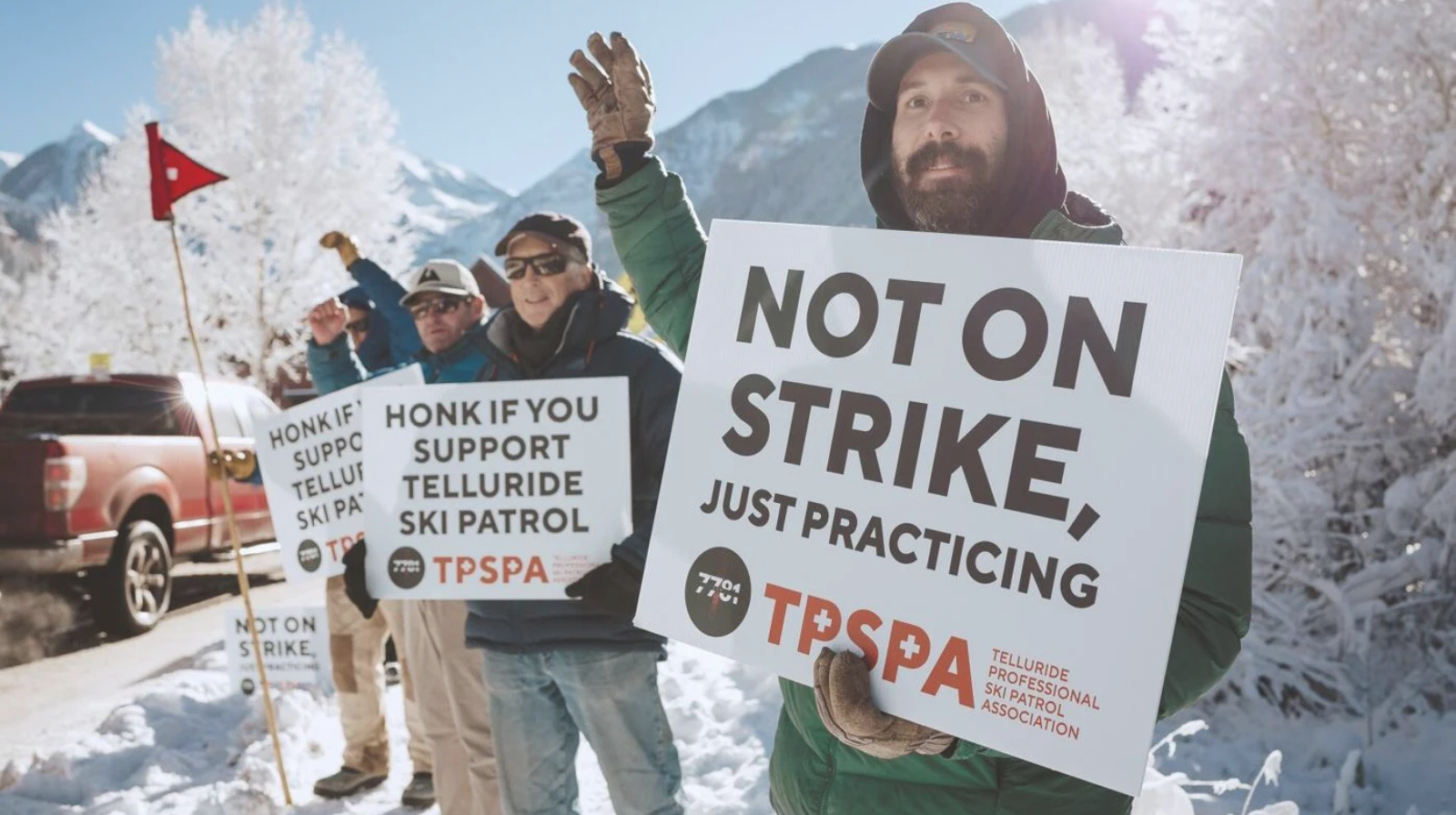
The day before, the union held a practice picket at Telluride’s entrance. Hoffman said the turnout was strong: “The stoke was high, and everyone that passed through was enthusiastic and honking their support.” The patrollers also collected food donations during the demonstration.
Two final meetings are scheduled for December 5 and 6. The resort opens December 6, after warm weather delayed Thanksgiving operations. Without significant progress, the strike becomes likely.
Still, the union maintains that striking is their “absolute last resort.” “We don’t want to go down this road,” Hoffman told The Denver Post. “We know what this is going to do to the community and we love this community, this is our community.” Members have invested nearly 100 unpaid hours in negotiations this summer, demonstrating their commitment to reaching an agreement through conventional channels. But management’s position has barely moved beyond the initial 2.5 percent offer.
Yet Teleski defends its stance by claiming wages already align with Park City and Breckenridge, and has accused the union of bargaining in bad faith. The company also maintains it cannot single out patrol for higher wages when other resort workers earn less. The union counters that patrol work requires specialized certifications and skills those other positions do not demand.

Beyond Telluride
The outdoor recreation industry now generates $1.1 trillion in annual economic output, accounts for 2.2 percent of GDP, and employs 5 million Americans. Yet as one Workers United organizer put it, “These growth spurts often leave behind the workers who made that happen.”
For decades, the ski industry has run on a trade-off: modest wages for mountain life and a free pass. In the words of one Park City patroller, “Seasonal workers in all aspects of the outdoor world have been underpaid for so long because our jobs are deemed fun, which then seems to negate the fact that we’re providing labor.” But the arrangement held only when resort towns were still affordable for workers. That era is over. In Breckenridge, just 25 percent of housing is available to the workforce. When 45 percent of Telluride’s housing sits empty and rent exceeds a patroller’s monthly pay, passion is no longer a viable subsidy.
The patrollers handling explosives at 4 a.m. commute 40 minutes from bedroom communities because they cannot afford to live in the town they keep safe. The wages they seek would reflect the years required to learn where each slope loads after a storm, which trigger points might bury a skier, how to evacuate a broken body from a cliff band in a whiteout. What they are rejecting is the assumption that their love of skiing should be factored into the wage calculation.
Park City demonstrated what happens when workers decide to use their leverage. Vail’s stock price, its holiday revenue, and its carefully cultivated brand all took hits the company could not ignore. Meanwhile, housing costs are not declining, and the pipeline of young workers willing to sleep four to a room is not infinite. Whether resort owners will act before more strikes force the issue remains to be seen.
The outcome at Telluride will resonate far beyond the San Juans. Workers at Jackson Hole, where per capita income exceeds $471,000 while patrollers start at $23 an hour, are paying close attention. So are organizers at Solitude, Arapahoe Basin, and resorts that have not yet seen a union card. The question hanging over December’s negotiations is not whether ski patrollers deserve a living wage. It is whether the industry will acknowledge that the old bargain is broken before more mountains go dark on opening day.
