

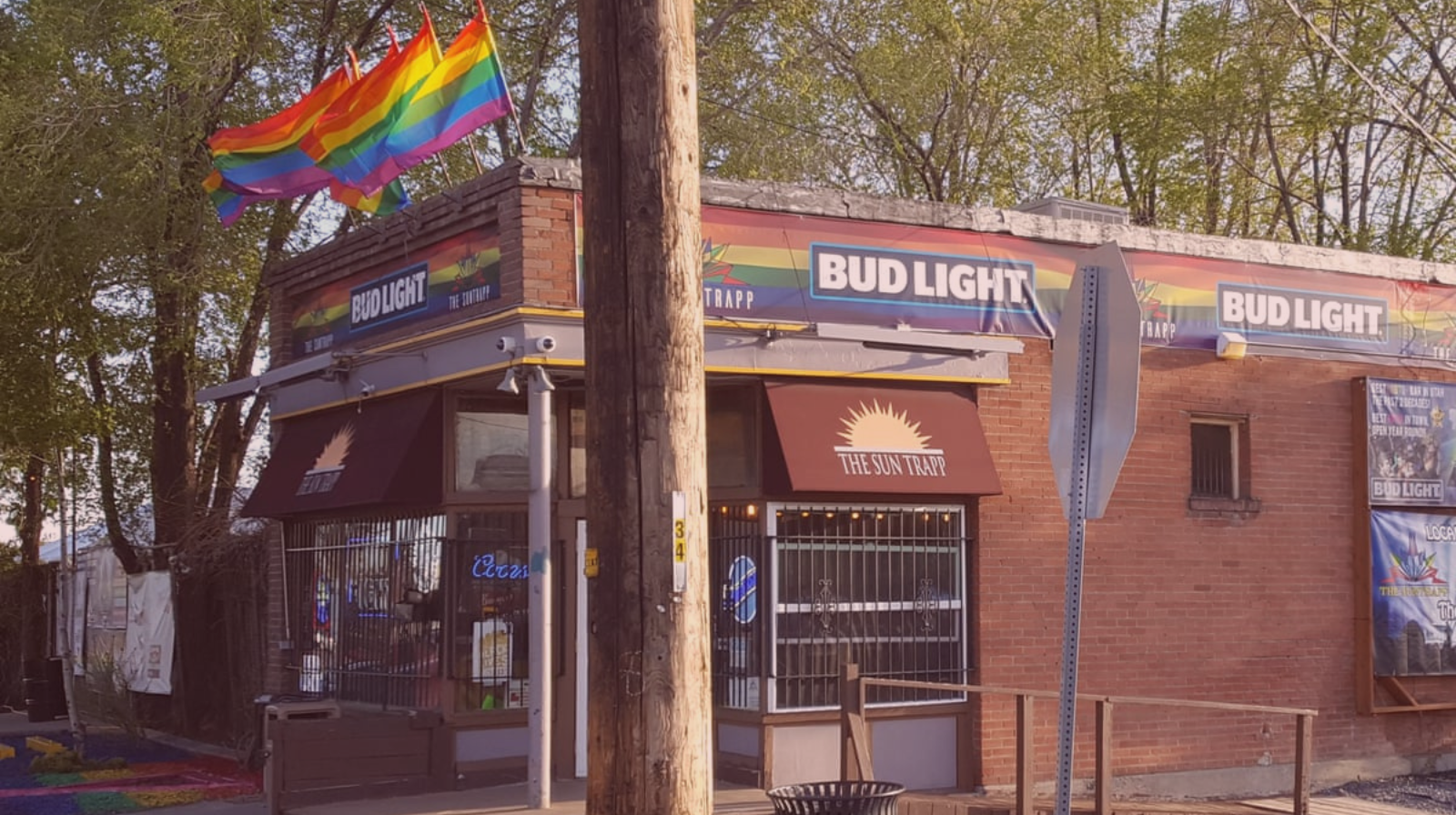
In the early hours of Halloween night, the neon lights of The SunTrapp flickered off for what could be the last time. Salt Lake City’s oldest continuously operating LGBTQ+ bar, founded in 1973 by Joe Redburn, had abruptly closed its doors just as employees were approaching a crucial milestone in their unionization campaign with CWA Local 7765.
The closure struck just as the National Labor Relations Board (NLRB) was effectively paralyzed by the federal government shutdown that began October 1. With no functioning labor board, organizers found themselves stripped of any avenue to challenge what they describe as an escalating pattern of retaliation. Here, in one shuttered bar, converged the fault lines of American labor: the vulnerability of worker organizing, the fragility of federal protections, and the endangerment of community institutions that serve as lifelines for marginalized people.
For lead bartender Natalie Jankowski, who discovered the closure through an Instagram post while preparing to picket that evening, the shutdown meant more than lost wages. “We organized out of love for The SunTrapp and the community it represents,” she told reporters gathered outside the locked bar, where a makeshift memorial of flowers and pride flags had begun to accumulate.

A Sanctuary Under Siege
The SunTrapp occupies sacred ground in Utah’s LGBTQ history. When Joe Redburn opened The Sun Tavern in 1973 at the corner of 400 West and South Temple, Stonewall’s ripple effects had barely reached the Mountain West. This was frontier territory for queer visibility, where Utah’s first disco ball spun above dancers who would later gather for a 1975 kegger in City Creek Canyon that evolved into the Utah Pride Festival. As LGBTQ activist Babs Delay noted, “the first version of the Utah Pride Center started at The Sun Trapp, making it not just a bar but the seeding ground of Utah’s entire LGBTQ+ infrastructure.”
For five decades, through various incarnations and ownership changes, the bar persisted as what employees describe as a “rare judgment-free zone” in a state often ranked among the least safe for queer people. In Utah, conversion therapy remained legal until 2020, same-sex marriage was banned by constitutional amendment, and LGBTQ+ youth attempt suicide at rates three times the national average. Against this backdrop, The SunTrapp was revolutionary in offering a place to exist without apology. Current owner Mary Peterson had reopened the venue in June 2024 after extensive renovations to the century-old building, pledging to maintain its legacy.
Such spaces carry significance that transcends their role as entertainment venues. As K Anderson, host of the Lost Spaces Podcast, observes: “People often talk about how we now have online spaces to access community, but that will never properly replicate a physical space. Gay bars offer a space to go where you have the freedom just to be.”
In a state where LGBTQ+ protections exclude public accommodations and queer youth experience higher victimization rates, The SunTrapp served as sanctuary where queer people could connect beyond the reach of homophobia and transphobia.
But this sanctuary’s promise collided with its own workplace realities. In September, a majority of staff signed union authorization cards, driven by mounting safety concerns, erratic scheduling, and the complete absence of benefits like health insurance or retirement plans. Their organizing effort marked uncharted territory as the first bar in Salt Lake City to attempt unionization, making The SunTrapp workers pioneers in both preserving queer space and asserting labor rights.

The Escalation
The retaliation, workers say, began within hours of delivering their union letter on September 26. Peterson’s immediate termination of the organizing workers, though quickly reversed, signaled the start of what they describe as a month-long campaign employing textbook union-busting tactics.
Yet despite the escalating tensions, workers maintained they were fighting for basic workplace protections. “A lot of us just want clear guidelines for discipline, a clear employee’s handbook,” explained Morgan Sturgill, another striking worker. “I think it’s pretty common practice here in town for owners to not offer any sort of benefits or retirement plans or 401K matching or health insurance, even if you are full time,” Jankowski added. “And I would like to change that.”
For her and her colleagues, the organizing effort reflected deep commitment to the space itself. In an interview with LaborWise, she explained that they felt unionizing was essential “because this bar would benefit from a contractual obligation between staff and ownership. A contractual obligation that holds ownership accountable and gives the queer staff a seat at the table… Greed has always triumphed over the scrupulousness that the Utah queer community deserves. Many staff members have watched this space shut down more than once due to blatant negligence from ownership. We couldn’t stand by and watch it happen again.”
Communication between Peterson and the workers has been virtually nonexistent since the strike began. They have had “nearly zero contact with Mary since we went on strike, aside from some threatening texts and a rejection to meet with us about the strike demands on October 30th,” Jankowski said.
Despite the turmoil, these realities remained largely invisible to patrons. “Customers would not necessarily see the poor working conditions because the bar staff ensures that customers have a space where they feel safe,” Jankowski said. But behind the scenes, staff lived with constant surveillance through cameras, fear of being fired for calling out sick or making small mistakes, and safety concerns that went unaddressed despite the political climate. “The entire staff knows that Mary does not take queer safety concerns as seriously as she should.”
In an October 10 video posted to social media, Peterson oscillated between contrition and self-justification. She admitted to making “a huge mistake” in firing the workers, claiming she “felt very, very threatened” and thought they might be attempting “a hostile takeover”. While acknowledging her legal obligation to rehire them, she insisted the business was “too small” to sustain unionization. This claim has no legal merit, as the NLRA grants organizing rights to employees regardless of business size.
But the divide deepened when Peterson fired the head of security, described as a “key union supporter,” in what workers called “blatant retaliation for protected union activity“. Peterson also instituted what workers described as “a wave of new, punitive policies clearly designed to intimidate and entrap staff.”
These actions triggered an unfair labor practice strike on October 3, mobilizing the community every Friday and Saturday night. What emerged was a labor dispute with existential stakes, drawing drag performers, regular patrons, and union activists into a collective defense of both workers’ rights and queer sanctuary.

The Federal Vacuum
The government shutdown that began October 1 unleashed a perfect storm for the embattled workers. The NLRB ceased almost all case handling, effectively suspending elections and investigations. Union elections and administrative hearings disappeared into indefinite postponement, filing deadlines frozen in regulatory paralysis.
For The SunTrapp workers, their scheduled election to formalize union representation simply evaporated. Without NLRB investigators to document violations, judges to hear cases, or mechanisms to certify unions, workers’ ability to exercise their right to form unions or hold their employers accountable was, as the Economic Policy Institute noted, ‘on hold indefinitely.’
Management cited this regulatory paralysis in their closure announcement, stating “the financial impact of consistent protests has made it impossible for us to remain open” while simultaneously blaming the federal paralysis for preventing the very vote that might have resolved the dispute.
Workers exercising federally protected rights found themselves abandoned by the federal apparatus created to protect them. The shutdown had transformed a labor dispute into a test case of what happens when federal oversight simply vanishes, leaving employers free to act without regulatory consequences.
Federal operations resumed on November 13 when Trump signed emergency funding legislation, but the workers’ fight is far from over. Jankowski spoke with the NLRB this week and was told they would have an election date “by the beginning of next week at the latest” and that it would happen within 30 days. Peterson’s lawyers have indicated they want to proceed with an election. While the union remains publicly optimistic, Jankowski expressed concern about Peterson’s willingness to bargain in good faith should the union win.

Community Consequences
While Peterson blamed financial losses from the strike for the closure, union organizers noted that Peterson ‘has decided to splurge on lawyers, additional security, and to eat the cost of her pride in lost business’ rather than negotiate, calling the closure ‘bewildering’ given that addressing their concerns would cost ‘literally nothing’.
Jankowski estimates Peterson chose to “lose nearly $200,000 in gross revenue over two months of striking than meet our FREE strike demands. She would rather strip the Utah queer communities’ safe space away from them than admit her shortcomings as a boss.”
The closure has taken a significant financial toll on the workers too. “This has been a massive struggle for the staff,” Jankowski said. “We have been supplementing our income with gig work, but we would much rather be at the Suntrapp. We love our jobs and miss serving the community.”
Yet in Utah’s right-to-work environment, where union density at 3.7% remains among the nation’s lowest, even baseline requests for written policies, scheduling protections, and benefits represented a fundamental challenge to managerial prerogative. The SunTrapp workers found themselves confronting not only their employer but decades of state policies unfavorable to unionization.
Jessica Stauffer, president of CWA Local 7765, emphasized the unique challenges of organizing in such an environment: “Asking bosses for voluntary recognition and for better working conditions is really hard overall. We would be working more than eight-hour days or 40-hour weeks without unions.”
Meanwhile, the organizing effort has faced resistance from unexpected quarters. “We have faced extreme scrutiny from the older generation of queers,” Jankowski said. “The main narrative they’re pushing is that if we don’t like our jobs, we can just leave and find a new one. That we are straight terrorists that just wanted to shut down a queer space.”
These internal divisions underscore how deeply the bar’s closure reverberates far beyond labor relations, striking at the heart of what researchers call ‘sexual minority stress‘ and the crucial role of community spaces in mitigating it. Hundreds of gay bars have closed in recent years, each representing not just a business failure but ‘the erasure of LGBTQ+ culture.’
While mainstream bars have become more welcoming, inclusivity remains “conditional, based on things like money, looks and behavior.” Dedicated LGBTQ+ spaces offer sanctuary and intergenerational connection that online spaces cannot replicate.
Tony Parrott, a drag performer banned for joining picket lines despite hosting shows there that week, was blunt: “When you open or take ownership of a queer space, you’re obligated to make it a safe space. You take an oath to the community.”

Legal Limbo
Under Utah law, bars must file for temporary closure seven days before they intend to close. Peterson filed the required notification, and The SunTrapp officially closed on November 1. Her statement that she’s “not certain what the path looks like” suggests the closure’s permanence remains undetermined, leaving workers and patrons in suspense.
The language of “temporary closure”, however, fits a well-documented pattern in labor disputes. Starbucks and Chipotle closed stores during active union drives, citing “safety issues” or “staffing problems,” and labor scholars note that companies can find a reason to close almost any store. While the NLRA prohibits closures meant to chill unionism, proving intent requires extensive investigation.
Temporary closures allow owners to reset their workforce without explicitly firing anyone. As documented by the Emergency Workplace Organizing Committee, this “store closure or layoff strategy” lets employers claim “business necessity” rather than targeted retaliation, avoiding the legal scrutiny that mass firings would trigger. If Peterson advertises for new staff during the closure or reopens with a substantially different workforce, it could constitute illegal retaliation.
On top of that, the shutdown created immediate legal complications for the workers. When Jankowski contacted the Department of Alcoholic Beverage Services about the temporary closure, she was told she is “not on record as an employee,” raising questions about workers’ standing to pursue their organizing campaign or file unfair labor practice charges.
This creates a catch-22: with the bar closed, they may no longer be considered employees with grounds to pursue unfair labor practice charges. Yet the closure itself may constitute illegal retaliation that the NLRB should investigate. Labor scholars call this “process as punishment“, where delays and procedural obstacles effectively deny workers their rights even when the law is nominally on their side.
The workers, for their part, have been strategic about when to play their hand. Jankowski says they have compiled “a master doc with over 20 ULPs that Mary has collected since we proposed our union” but have chosen not to file them yet. “We intend to file them after our election is won,” she explained. “If filed, we believe Mary’s lawyers will use the ULPs as a means to avoid an election by fighting one ULP at a time, which could take months.”
Meanwhile, mutual aid networks have mobilized to support striking workers who lost their primary income source overnight, with a solidarity fund on GoFundMe embodying the community care ethos that has long sustained marginalized communities.

An Uncertain Future
The SunTrapp case illuminates converging crises in American labor relations and LGBTQ+ community survival. Small employers in culturally significant venues can weaponize their community importance against organizing workers, essentially holding patrons hostage to labor disputes.
The case also illustrates the compounded vulnerabilities of workers in marginal communities. LGBTQ+ employees at The SunTrapp weren’t only risking their livelihoods but access to one of their community’s few remaining gathering spaces. David Cooley of The Abbey in Los Angeles describes these venues as “unofficial town halls” that foster local communities and advance LGBTQ rights. That status gives employers in identity-based businesses unusual leverage against organizing, layering precarity upon precarity.
Despite the challenges, the workers are looking beyond their own campaign. “Immediate next steps for us are starting our community organizing movement,” Jankowski said.
“Anyone who does not work at an establishment cannot attest to the working conditions, even if they patronize the bar daily,” Jankowski said. “No one knows but the staff. We want our patrons to know the longevity of this space is at the forefront of our priorities. It is our personal mission to keep this bar alive and well and, most importantly, make it as safe as possible.”
The case joins a growing chronicle of service sector organizing efforts that have met fierce resistance, from Starbucks to REI to independent bookstores. Yet The SunTrapp’s particular circumstances, in which regulatory paralysis enabled potential union-busting during a critical election period, sets a troubling precedent for small workplace organizing efforts. Whether The SunTrapp’s lights will shine again remains uncertain. What’s clear is that its darkness illuminates the precarious state of worker rights when federal protections evaporate and community institutions become battlegrounds. For now, the corner of 600 West and 100 South stands empty.
