

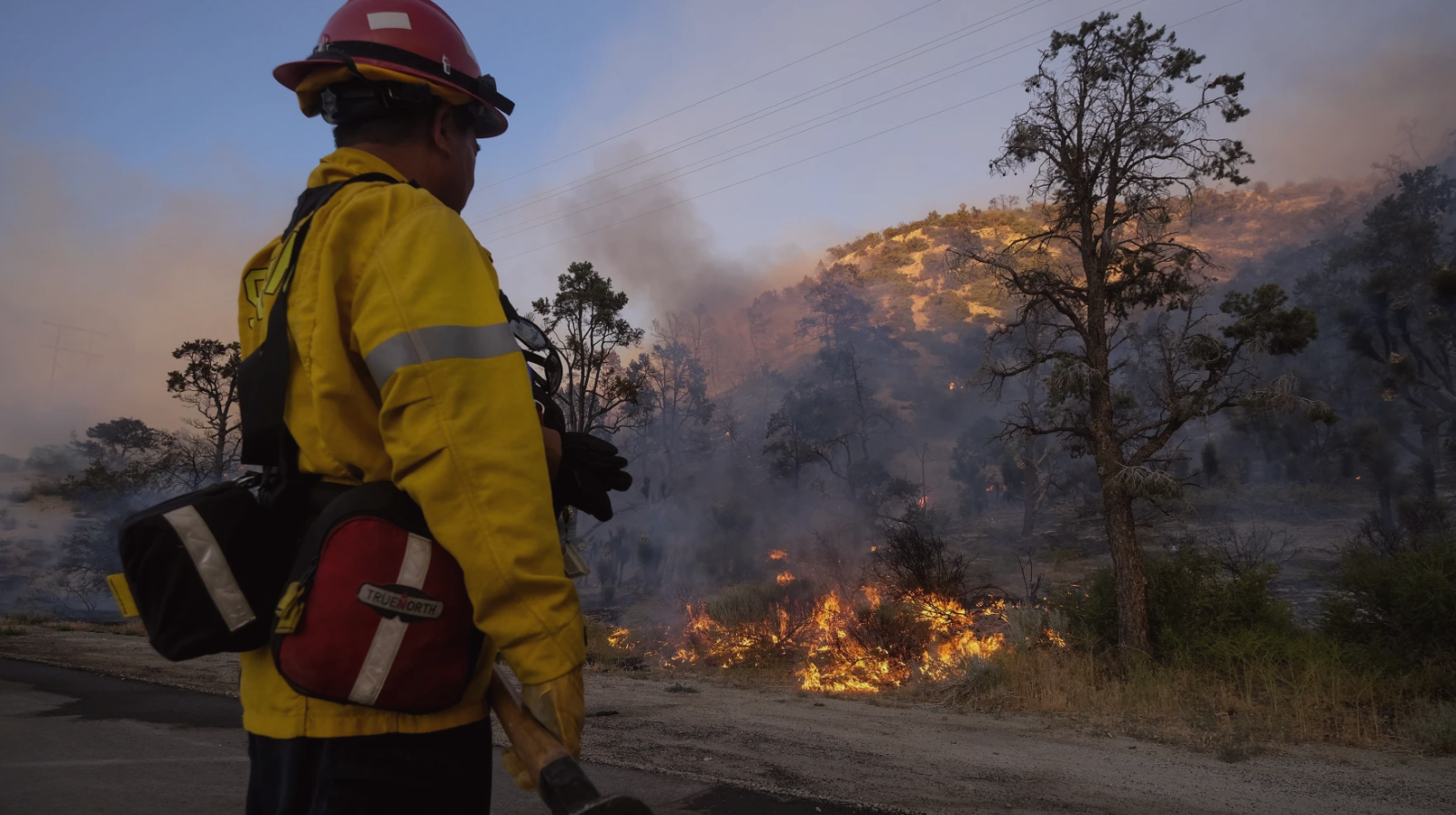
Fernando Allende spent years fighting fires with nothing but a cloth bandanna to protect his lungs. During the Los Angeles fires in early 2025, he worked for seven months straight in smoke so thick it carried the acrid stench of burning plastic, conditions that left his crew coughing up black mucus and collapsing from dizziness. In June 2025, while fighting another fire, he suddenly couldn’t breathe. At the hospital, doctors found blood clots in his lungs and a mass pressing against his heart. The diagnosis arrived as high-grade B-cell lymphoma, an aggressive cancer typically seen in patients decades older.
Allende’s lymphoma was the devastating consequence of institutional negligence perpetuated for decades before he ever put on a uniform. The U.S. Forest Service had long possessed research proving wildfire smoke causes cancer, and agency scientists had recommended respiratory protection starting in the 1990s. Yet leadership not only declined to provide masks but actively prohibited firefighters from wearing them, even at their own expense.
Each time occupational disease re-emerges in America, it’s treated as an isolated scandal: a company caught, a policy reformed, a settlement reached. But the institutional response to poisoned workers remains unchanged across a century. The variables shift (radium paint, asbestos fibers, coal dust, wildfire smoke) but the machinery operates identically. Workers die while institutions contest causation and delay protection. Understanding this pattern matters because worker deaths are treated as budget decisions, not tragedies, and the institutions making those decisions will not reform themselves. Waiting for them to do so has proven fatal.

The Precedent
In 1917, as the United States entered World War I and demand surged for luminous military instruments, the U.S. Radium Corporation hired young women to paint watch dials with radium-based paint. Management assured them the glowing substance was safe, even beneficial to their health. Supervisors encouraged the “lip pointing” technique, instructing workers to use their mouths to create fine points on their brushes. They ingested radium with every stroke. But behind closed doors, the company’s own scientists had already documented what ingesting radium did to bone and tissue. As historian Kate Moore documented, radium firms “controlled, to an almost monopolizing extent” the element’s image and most of the knowledge about it, publishing their own medical research to promote radium’s therapeutic benefits while concealing evidence of lethality.
Then teeth started falling out. Jawbones crumbled in their doctors’ hands. Women developed debilitating cancers that hollowed out their insides. But company doctors misdiagnosed them with syphilis rather than radium poisoning. Lawyers buried the dying women in litigation and investigators threatened anyone who dared to speak out. The litigation that finally forced accountability came too late for dozens of workers, most of them dead by their mid-twenties. But the case established a legal precedent: workers could sue corporations for occupational disease.
With asbestos, the industry engineered an even more sophisticated apparatus of denial. In the 1930s, mining companies and manufacturers identified asbestos as the cause of devastating lung diseases in their workers. After funding studies documenting precisely how asbestos ravages human lungs, they knowingly locked away the evidence. Then when independent researchers began publishing similar findings, industry associations targeted the scientists themselves and commissioned counter-research to muddy the science. Internal memos from the 1950s reveal executives discussing their approach with striking candor: acknowledge nothing, admit nothing, delay everything.
Workers at Johns-Manville and other manufacturers died from mesothelioma and asbestosis. Company doctors misattributed their disintegrating lungs to tuberculosis or cigarettes. When an internal report in 1943 confirmed the link between asbestos and cancer, the company buried it. Four decades of profit passed before federal regulation materialized. By then, thousands of workers had already choked on scar tissue their employers knew asbestos would produce.
By the early 1900s, medical literature had established that coal dust destroyed miners’ lungs. Yet operators denied “black lung” existed as a distinct disease. Company physicians blamed pneumoconiosis on bronchitis or emphysema to avoid liability. Owners knew that fighting compensation claims cost less than installing ventilation. Not until 1969, after decades of organizing by miners and their widows, did regulations arrive. By then, over 100,000 miners had suffocated on coal dust their employers knew would kill them.
The lead industry expanded the duplicitous strategy beyond workers, marketing poison directly to families. Despite clear evidence of lead’s neurological effects, manufacturers launched colorful campaigns depicting lead paint as safe for nurseries and children’s bedrooms. When research linked lead exposure to childhood brain damage, the Lead Industries Association funded counter-research and destroyed scientists’ careers. Lead paint remained legal for residential use until 1978 while the phaseout of leaded gasoline dragged into the mid-1990s. An entire generation of American children absorbed heavy metals into their developing brains while their parents believed they were making safe choices.
Across these industries, the apparatus of denial operated with ruthless consistency. Tactical arguments purchased decades of continued profit at the price of workers’ destroyed lungs, disintegrated bones, and children’s diminished minds.

The Contemporary Application
Tens of thousands of wildfire fighters spend weeks working in toxic smoke without respiratory protection. Unlike urban firefighters, who would never work without respiratory protection, federal wildland firefighters have been prohibited from wearing masks for decades. The prohibition was a deliberate policy choice, maintained despite mounting evidence of harm.
After massive fires in Yellowstone in 1988 sickened over 10,000 firefighters, the U.S. Forest Service’s own researchers began studying smoke exposure systematically. They documented that wildland firefighters face exposure to at least 31 known carcinogens. They published studies linking smoke exposure to cardiovascular disease, lung damage, cancer, and premature death. Agency scientists recommended respiratory protection starting in the 1990s.
George Broyles, a former firefighter who became a smoke researcher for the Forest Service, described the agency’s motivation simply: “They didn’t want to know, because then they’d have to do something.” The agency’s own files documented the financial concerns driving inaction. Admitting the danger would require more crews for rotation, actual lodging instead of smoke-filled camps, and larger budgets. Workers’ compensation claims would inevitably follow.
When the Department of Labor proposed a requirement in 2024 that wildfire crews be given masks, Forest Service officials pushed to kill the mandate. Through the National Wildfire Coordinating Group, an interagency body the Forest Service effectively controls, they submitted formal opposition. The protections would be “ruinously expensive,” they argued. The same agency sending workers into carcinogenic smoke deployed lawyers to prevent those workers from covering their faces.
Only investigative journalism could force a reversal. After The New York Times published its investigation in August 2025, Congressional leaders pressed the Trump administration with pointed questions: When will you require respiratory protective equipment? How much would it cost? Following the pressure, Forest Service Chief Tom Schultz announced a policy change. Firefighters could now wear N95 masks voluntarily, but only during light duty work. The ban persisted for everything else. Digging fire lines? No masks. Cutting trenches through smoke so thick it obscures visibility? Still prohibited. The new policy provided masks when firefighters faced minimal exposure and maintained the ban during the labor most likely to kill them.
Firefighter advocates immediately called out the inadequacy of this response. Bobbie Scopa, a retired federal wildland firefighter and member of Grassroots Wildland Firefighters, was blunt: “N95s are not the answer to our problems.” The masks require a clean seal to be effective, making them difficult for firefighters with facial hair to use, and they typically do not stay in place during intense manual labor. Because the masks are not mandatory, Scopa said wildland firefighters are unlikely to use them regularly.
For Fernando Allende, the second betrayal came when he filed for workers’ compensation. Congress had granted federal firefighters workers’ compensation coverage in 2022 for more than a dozen cancers, along with COPD, heart attack, and stroke. Three years later, the Trump administration slashed administrative staff at the Office of Workers’ Compensation Programs. Claims stalled. Wait times stretched for months. Between Allende’s diagnosis and the start of chemotherapy, the tumors in his chest expanded significantly. Without the paycheck and health coverage that workers’ compensation should provide, he delayed his second round of chemotherapy while searching for a doctor who would accept his limited insurance.

The Modern Pattern Proliferates
The retrogressive logic that sacrificed wildfire fighters operates across industries that appear unrelated but share the same underlying calculus. Warehouse workers collapse from heat stroke during mandatory overtime in facilities without adequate cooling. Semiconductor fabrication workers lose their vision in their twenties from chemicals so new they lack established safety limits. Farmworkers absorb pesticide levels in their blood 400 times the national average while remaining the only major workforce in America explicitly excluded from OSHA jurisdiction. In each case, the sequence repeats: evidence accumulates, companies declare protection too expensive, workers sicken, regulatory response arrives years or decades late if it arrives at all.
OSHA proposed its first heat safety standard in August 2024, more than half a century after the agency’s creation, and only after warehouse workers began collapsing during summer shifts. The proposal arrived as bodies piled up. At Amazon’s San Bernardino air hub, employees crouched beneath Boeing 767 fuselages for shade when temperatures exceeded 100 degrees. Management provided no chairs for mandated cool-down breaks. Workers could stand upright in triple-digit heat or huddle under aircraft, a false choice that transformed heat stroke from possibility into inevitability. The Trump administration has since moved to delay implementation.
In semiconductor manufacturing, women working with chemicals that entered production without completed safety studies developed cancer and lost pregnancies at elevated rates. The pattern was documented decades ago, yet production continued. OSHA itself admits that many permissible exposure limits governing worker safety today rely on science from the 1960s and 1970s, standards older than most of the workers they purport to protect. Meanwhile, comprehensive reform stalls while new chemicals enter production faster than regulators can assess whether they will blind workers or kill their unborn children.
The failure to protect agricultural workers stands apart in its totality. Between 10,000 and 20,000 farmworkers, predominantly Latinx, experience acute pesticide poisoning annually according to EPA estimates, though accounting for undiagnosed cases pushes the number toward 300,000. Their children absorb pesticides through the contaminated work clothes parents carry home, poisoned by compounds approved as safe for agricultural use. Farmworkers remain the only major workforce in America explicitly excluded from OSHA protection. The agency responsible for their safety is the EPA. The same entity approved the pesticides destroying their health in the first place. In recent years, inspectors examined barely one percent of farms using pesticides. They found violations at nearly half the facilities they did inspect.
The pattern extends to PFAS manufacturing, where workers handle “forever chemicals” linked to cancer and developmental damage. The EPA designated certain PFAS as hazardous only in April 2024, after decades of industrial use had already exposed workers to compounds that will persist in their bodies and the environment for generations. Regulations now address contamination in rivers and drinking water, the pathways that affect the general public. But workers manufacturing these chemicals, who face the highest exposure levels of anyone, remain largely excluded from those protections. The priorities are explicit: protect the public from chemicals in their water while allowing continued exposure for the workers who make them possible.

Bodies as Externalities
The wildfire season begins again in six months. Tens of thousands of firefighters will wrap cloth bandannas around their faces, or nothing at all, because that is still all the Forest Service allows during the work most likely to kill them. What happened to Fernando Allende is happening right now. The machinery is intact and operating.
The institutions responsible for this have names and addresses. The National Wildfire Coordinating Group, effectively controlled by the Forest Service, submitted formal opposition to mask requirements in 2024, arguing that protecting firefighters would be “ruinously expensive.” The Trump administration officials who slashed more than 90% of NIOSH’s workforce in 2025, eliminating the research capacity that documents how work kills people, made specific decisions with specific consequences. Elon Musk and Russell Vought, the architects of the deregulation agenda, are real people who can be named, contacted, and confronted.
These institutions will not reform themselves. The Forest Service’s September 2025 mask policy, arriving only after The New York Times investigation forced their hand but still banning masks during the most dangerous work, proves that pressure produces only the minimum concession required to make the pressure stop. Real change requires making the pressure unbearable.
Investigative journalism is the mechanism that makes invisible harm visible. Organizations like ProPublica and worker-focused outlets need resources to continue documenting what institutions prefer to hide. Grassroots Wildland Firefighters, the union organizing federal firefighters, is fighting for the protections the Forest Service refuses to provide. The United Farm Workers continue organizing the workers most systematically excluded from protection. Amazonians United is organizing warehouse workers without formal union structure because traditional labor organizing cannot keep pace with the speed at which workers are being harmed. These organizations need money and political support.
OSHA operates with enough inspectors to visit each workplace under its jurisdiction once every 165 years. Congress controls OSHA’s budget. Call your representatives to demand emergency appropriations for annual inspections of every high-hazard workplace, restoration of NIOSH’s research capacity, and an end to the explicit exclusion of agricultural workers from OSHA jurisdiction.
Fernando Allende is thirty-three years old. The tumors pressing against his heart grew while he waited for workers’ compensation approval that should have been automatic, and he spent months fighting for medical care after smoke his employer prohibited him from escaping gave him cancer. He knows what wildfire smoke looks like now. It looks like poison. The firefighters suiting up for the next fire season are wrapping bandannas around their faces today. The Forest Service still employs the officials who fought to keep them unprotected. The machinery that sacrificed Fernando Allende remains intact. The only question is how many more bodies it will take to destroy it.
