

In the sprawling Boeing facilities across Missouri and Illinois, workers spend their days building some of the most sophisticated military hardware on Earth. F-15 Eagle fighters. F/A-18 Super Hornets. The T-7A Red Hawk trainers that will teach the next generation of Air Force pilots. The MQ-25 Stingray drones that represent the cutting edge of unmanned aerial warfare.
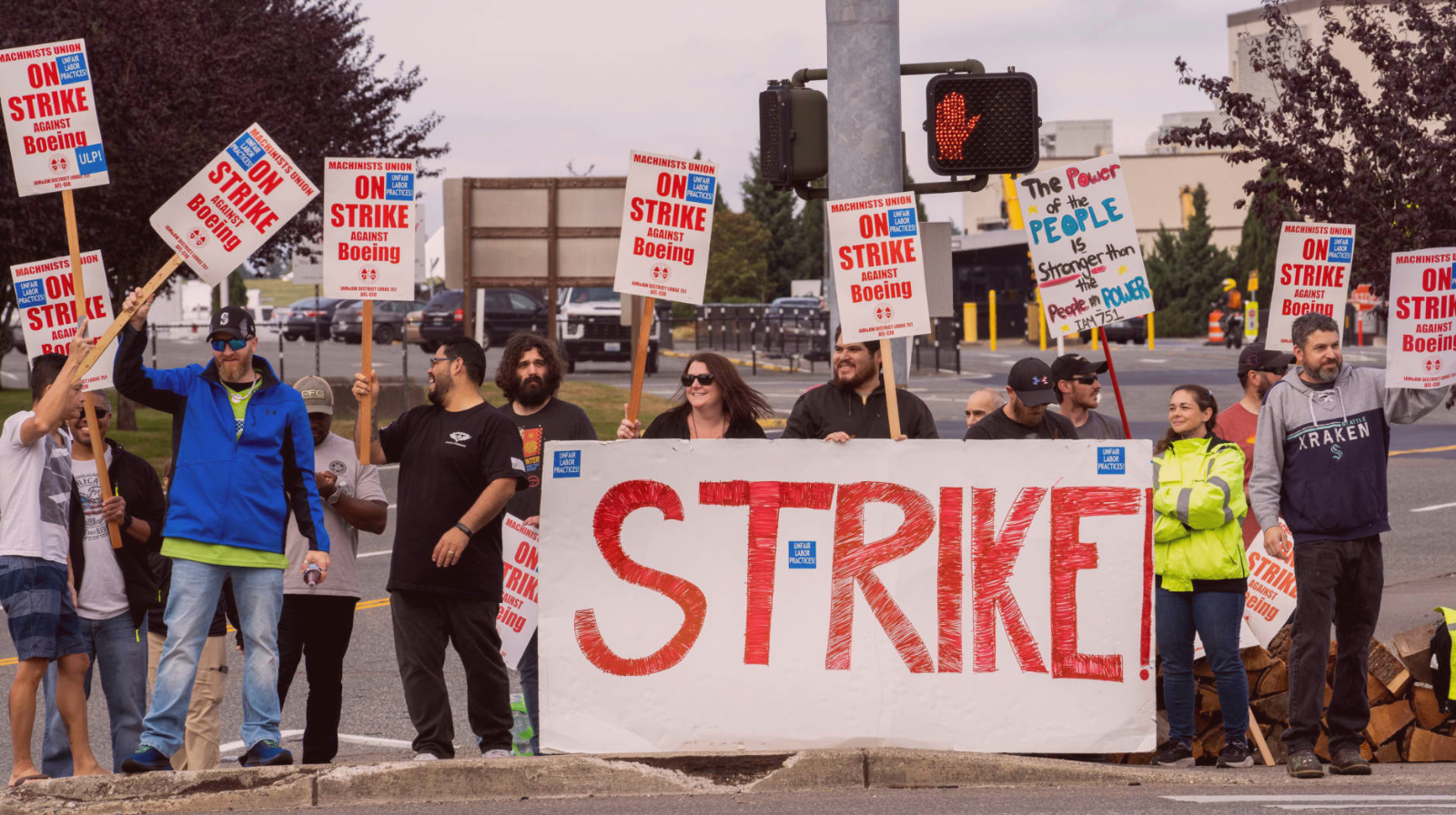
These are the machines that project American military power across the globe. And in early August, more than 3,200 of the skilled workers who build them walked off the job.
Their employer offered them a 20% wage increase. They said no.
In an economy where most workers are told to be grateful for cost-of-living adjustments and where job security is a luxury, defense contractors represent something close to the American Dream of stable employment. Good pay, solid benefits, work that matters to national security, and the kind of job security that comes with building weapons systems the government will always need.
So when workers with these supposedly “good jobs” go on strike for the first time in nearly three decades, it raises a question: what’s broken about work in America? If even the people building our fighter jets don’t feel secure, who does?

The Deal They Rejected
Boeing Air Dominance vice president Dan Gillian called it “the richest contract offer we’ve ever presented to IAM 837.” He claimed it addressed “all their stated priorities.”
The numbers looked good on paper: 20% wage increases over three years, plus a $5,000 signing bonus. Boeing said the increases could average about 40% taking into account other improvements. That would bring average IAM 837 machinist pay to more than $102,000 from $75,000.
In most industries, workers would leap at that offer.
But these workers, represented by the International Association of Machinists Local 837, had priorities that went beyond the headline wage number. They were fighting against decades of union-backed concessions. The elimination of company-paid pensions. The implementation of a two-tier wage system. The rejected deal would have required new employees to work for at least 12 years to reach top pay.
Think about that: workers turned down a 20% raise because they refused to accept a system where their younger colleagues would spend over a decade earning less money for the same work.
As IAM District 837 Directing Business Representative Tom Boelling stated: “IAM District 837 members have spoken loud and clear. They deserve a contract that reflects their skill, dedication, and the critical role they play in our nation’s defense.”

The Two-Tier Trap
The two-tier wage system that Boeing workers are fighting represents one of the most insidious ways modern employers have learned to divide workforces while cutting long-term costs.
New hires get lower wages and inferior benefits. Sometimes permanently. Sometimes with the promise of eventual parity that may never come.
It’s a strategy that pits workers against each other. Senior employees get to keep their current pay and benefits, so they’re less likely to fight the company. New workers start at lower wages but are told they should be grateful just to have jobs. The result is a workplace where people doing identical work earn vastly different wages based solely on when they were hired.
For the Boeing defense workers, this went beyond fairness in the abstract. It was about the future of their industry and their union. Accept two-tier wages, and you’ve accepted that the work they do building the military hardware that keeps America’s technological edge somehow became less valuable over time. Accept that newcomers deserve less for the same skills, and you’ve undermined the basic principle of collective bargaining: that the value of the work should determine the wage, not when you happen to get hired.
Boeing’s elimination of traditional pensions in 2014 added insult to injury. These workers build machines designed to last for decades, protecting American interests worldwide. But the company that profits from their expertise won’t guarantee them security in retirement.

When Job Security Isn’t Secure
Defense contractor positions are supposed to be among the most stable jobs in the American economy. The Pentagon will always need new weapons systems, upgrades, and maintenance. Workers often need security clearances, creating additional barriers to entry that should theoretically protect their positions.
But stability for the employer doesn’t automatically translate to stability for workers. Even in defense contracting, companies have learned to externalize risk onto their workforce. Traditional pensions disappear, replaced by 401(k) plans that fluctuate with market conditions. Two-tier wages ensure that labor costs decrease over time as older workers retire and are replaced by cheaper alternatives.
The promise becomes: you can have job security, but only if you accept decreasing economic security.
This is the contradiction these Boeing workers refused to accept. They build the most advanced military technology in the world, yet they’re asked to accept that their own economic future should be less advanced, less secure, than what previous generations of defense workers enjoyed.

Eight Weeks and Counting: The Strike Intensifies
What started as a principled stand in August has become a test of endurance and corporate power dynamics. By late September, the strike had lasted eight weeks with Boeing now hiring permanent replacement workers to maintain production. The strike has taken several dramatic turns:
- September 10: Boeing and the union reached a tentative agreement on a five-year deal. It included better wages and a signing bonus.
- September 12: Workers voted 57% to 43% to reject Boeing’s third contract offer. According to the union, “Boeing’s modified offer did not include a sufficient signing bonus relative to what other Boeing workers have received. It also lacked a raise in 401(k) benefits.”
- September 19: In an unprecedented move, workers voted 90% to approve a union-drafted contract that addressed their core concerns. The proposal included annual general wage increases of 8%, 4%, 4% and 4% over four years, plus a $10,000 ratification bonus. It also offered 100% company match on the first 8% of employee 401(k) contributions.
Boeing’s response was swift and dismissive. Dan Gillian called the union leadership’s offer “not real.” He claimed it was “a publicity stunt that’s a waste of your time.”

A $40 Million Question and Congressional Intervention
The company’s rejection of a 90%-approved worker proposal illustrates the power dynamics these workers are fighting against. When workers organize, research, and democratically approve their own contract terms, the company dismisses it as “not real.” But when the company unilaterally decides what workers should accept, that’s supposedly legitimate negotiation.
IAM Resident General Vice President Jody Bennett called Boeing’s dismissal “both insulting and dishonest,” noting that “Boeing has received an email and hard copy of our membership-ratified proposal and request for meeting dates and times.”
According to union calculations, the difference between Boeing’s rejected offer and the union’s ratified agreement amounts to roughly $40 million, not much more than what Boeing’s former CEO Dave Calhoun received in a $33 million golden parachute, or current CEO Kelly Ortberg’s $18.4 million compensation in 2024.
By contrast, workers are asking for $10,000 each to return to the job of building and maintaining America’s most advanced defense aircraft.
The standoff has now attracted significant political attention. Members of the Congressional Labor Caucus and U.S. Reps. Wesley Bell (D-Mo.) and Emanuel Cleaver (D-Mo.) have sent letters to Boeing CEO Kelly Ortberg urging the company to resolve the strike and negotiate a fair contract.
Even Republican Senator Josh Hawley from Missouri has entered the fray. He made scathing comments about Boeing executives: “I mean, these people have strip mined that company. The C-Suite is doing great over at Boeing. Their workers are the ones who’ve been getting the shaft. The problem is the workers are the ones who make the planes. So if you want anything to work, it’s got to be the good people who are on the line, the engineers and the designers, they’re the ones who Boeing needs to do right by and they haven’t.”

Beyond the Defense Industry
The Boeing strike illustrates a startling truth about the state of American work. If workers with relatively privileged positions, good wages, important work, and job security still feel compelled to walk off the job, it suggests that the problems with American labor relations go deeper than just pay scales.
When workers turn down significant wage increases to fight two-tier systems, they’re making a statement about dignity and fairness that transcends their individual situations. As IAM Midwest Territory General Vice President Sam Cicinelli said: “IAM District 837 members build the aircraft and defense systems that keep our country safe. They deserve nothing less than a contract that keeps their families secure and recognizes their unmatched expertise.”
The fact that this is Boeing’s second major strike in less than a year, following the massive commercial aircraft workers’ strike in 2024 that lasted 53 days, suggests these aren’t isolated incidents but symptoms of a broader breakdown in how corporations treat their workforce.

The Real Cost of “Competitive” Labor
Boeing and other defense contractors operate in a unique space where national security meets private profit. These companies receive billions in government contracts, often with cost-plus arrangements that virtually guarantee profitability. Boeing’s defense unit contributed about 30% of the company’s $42 billion in revenue in the first half of this year. Yet they still implement the same labor cost-cutting strategies used by companies operating in truly competitive markets.
The result is that American taxpayers fund both the weapons systems, and indirectly, the corporate strategies that squeeze the workers who build those systems. We pay for the contracts that generate Boeing’s revenue, then watch as the company uses that revenue stream to justify cutting worker benefits and implementing two-tier wage structures.
When defense workers strike, they expose a fundamental asymmetry in the military-industrial economy: public contracts enrich private shareholders while the workers who manufacture the weapons bear the financial insecurity.

The End of “Grateful to Have a Job”
Boeing defense workers rejected a 20% wage increase and walked off the job for the first time in nearly three decades, repudiating not just a contract offer but the underlying assumption that has governed American labor for a generation: that economic insecurity is simply the cost of having a job.
These workers had what many would consider good jobs. They rejected a substantial pay increase. They did it because they refused to accept that their colleagues should earn less for the same work, and they refused to accept that retirement security should be a thing of the past.
Their strike, now entering its ninth week with no end in sight, represents a broader question about what we expect from work in America. Is a job supposed to provide just enough income to survive, or should it provide genuine economic security? Should workers accept deteriorating conditions because they’re told to be grateful for employment, or should they expect that their work provides a foundation for a dignified life?
The workers building America’s fighter jets have given their answer. Boeing’s dismissive response to their democratically ratified proposal suggests the company hasn’t been listening. But as Congressional support grows and the strike continues to disrupt defense production, the question becomes: how long can a defense contractor ignore the workers who build the weapons America depends on?
It’s worth asking whether the broader workforce recognizes the warning signs.
