

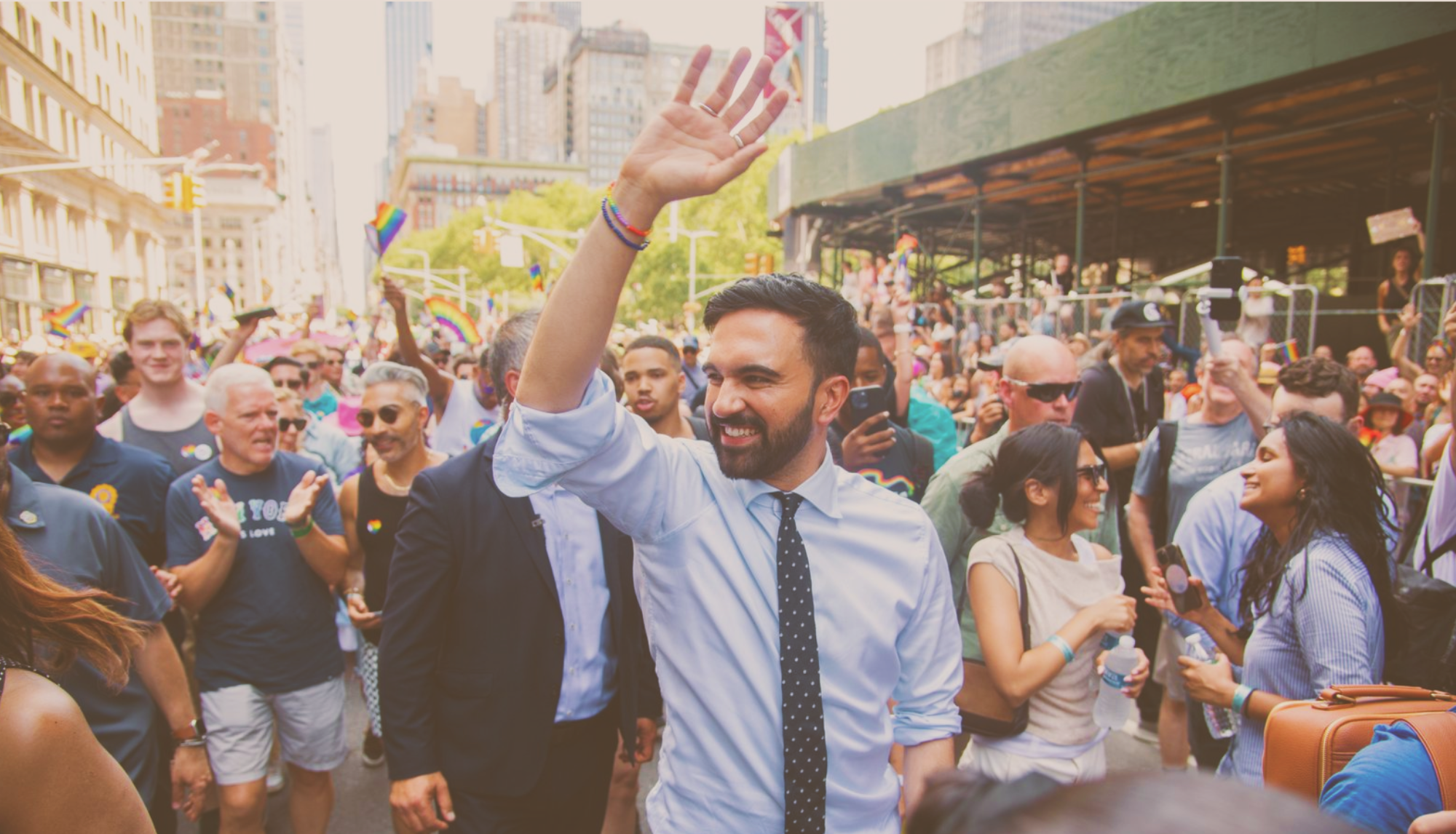
In the span of three months, Zohran Mamdani has gone from unlikely primary challenger to the favored candidate to run America’s largest city. His June 2025 Democratic primary victory in New York sent shockwaves through political establishments nationwide, but the real test begins now.
Leading recent polls with 40-44% support over former Governor Andrew Cuomo (25-28%), Republican Curtis Sliwa (10-17%), and incumbent Mayor Eric Adams (7-9%) according to multiple September 2025 surveys by Emerson College and Siena College, Mamdani faces a different challenge entirely. The question has shifted from whether a democratic socialist can win elections to whether workforce-centered politics can actually govern and reshape urban America.
The Coalition Is Proving Durable
What started as a protest vote against establishment politics has crystallized into something more substantial: a durable political coalition organized around economic survival. Bloomberg News analysis of the primary results revealed that Mamdani’s victory was driven by “younger and middle-class voters across Manhattan, Queens and Brooklyn” and specifically by “renters and the city’s middle class.”
Perhaps most telling: average turnout in precincts won by Mamdani was 36%, compared to 27% in areas won by Cuomo according to the Bloomberg analysis. This nine percentage point difference suggests deeper engagement rather than mere dissatisfaction.
“Zohran Mamdani’s win is the climax of a 10-year-long progressive populist struggle based on class and energizing new voters and young voters,” Democratic political strategist Trip Yang told Bloomberg. The numbers support this: more than 20,000 donors gave to Mamdani’s primary campaign according to the Bloomberg report, the most for any single candidate since 2001 except for Andrew Yang in 2021, while his grassroots operation mobilized around 50,000 volunteers who knocked on over 1 million doors.
What’s at play here isn’t protest but organization: politics born from shared material realities that conventional parties keep failing to meet.
Business Pushback as Validation
The establishment’s response to Mamdani’s primary victory has been swift and telling. According to Wikipedia’s comprehensive election coverage, “several business executives reportedly began meeting with Eric Adams as they considered backing him in the general election” immediately after Mamdani’s win was confirmed.
This reaction validates what labor organizers have long argued: that policies like Mamdani’s proposed $30 minimum wage by 2030, rent freezes on stabilized units, and universal childcare represent a fundamental challenge to how New York’s economy operates. The fact that the business community is organizing specifically to prevent these policies from being implemented suggests they understand their potential impact better than many political observers.
Mamdani’s platform goes beyond traditional labor issues to address what he calls “comprehensive public safety reform” and proposals for city-owned grocery stores according to his campaign website. These are policies that would fundamentally alter the relationship between workers, employers, and the city government. The establishment’s mobilization against these ideas proves they’re serious policy proposals, not just campaign rhetoric.

National Stakes for Worker Politics
What began as a local race has evolved into a national battleground over the future of urban labor politics. Trump has repeatedly attacked Mamdani, even threatening arrest if the assemblyman “interfered with U.S. Immigration and Customs Enforcement” operations as mayor, according to CNN’s July 2025 reporting. Trump falsely suggested Mamdani was in the country “illegally” (he is a naturalized U.S. citizen) and called him a “communist,” while praising Adams as “a very good person.”
This federal intervention transforms the NYC mayor’s race into something unprecedented: a direct confrontation between a local labor agenda and federal opposition. Mamdani has pledged to maintain New York’s sanctuary city status and provide legal representation for all immigrants in detention proceedings according to Wikipedia, policies that put him on a collision course with Trump’s deportation agenda.
The national implications extend beyond immigration. According to CBS News polling from September 2025, “by a factor of almost 2 to 1, New York voters would prefer the next mayor to generally oppose Mr. Trump than to work with him.” This gives Mamdani a strategic advantage, as he “draws two-thirds of those voters who want someone who would oppose Mr. Trump.”
For Republicans nationwide, Mamdani represents both an opportunity and a threat. As Syracuse University political science professor Grant Reeher told PBS NewsHour, “If I’m a Republican, I want this guy to win” presumably because they believe his policies will fail and discredit progressive governance. But that calculation assumes labor-focused policies can’t deliver tangible improvements to working families.
The Crowded Field as Labor Litmus Test
The fragmented general election field creates a unique test for workforce politics. Unlike a traditional two-party race, Mamdani must prove his labor coalition is strong enough to win against multiple alternatives: Adams representing continuity and business interests, Cuomo embodying Democratic establishment politics, and Sliwa offering a Republican alternative.
Recent polling reveals the complexity of this dynamic. While Mamdani leads in multi-candidate scenarios, Tulchin Research found that in a hypothetical head-to-head matchup, Cuomo would defeat Mamdani 52% to 41%. This suggests that opposition to Mamdani’s labor agenda is significant but divided among multiple candidates.
The fragmentation also reveals different approaches to economic policy. Adams has positioned himself as supporting “dignity in giving you a job” rather than “handouts,” according to CBS New York coverage, while Cuomo attacks Mamdani’s “rent-stabilized apartment in Astoria” (which Cuomo calls “Rentgate”) rather than engaging with housing policy substance per ABC7 reporting. Sliwa has focused on what he calls Mamdani’s “communist agenda,” reflecting a more traditional conservative opposition to worker-friendly policies.
For Mamdani’s coalition, this means the labor agenda must be compelling enough to attract not just progressive voters but also working-class New Yorkers who might otherwise support more moderate candidates.

Implementation Reality
Perhaps the most significant test facing workforce politics is the transition from campaign promises to governing reality. CBS News polling from September 2025 found that “New York City is overwhelmingly described by its voters as unaffordable,” while “voters’ desire for a mayor they believe can bring change outpaces their desire for one with experience.”
This creates both opportunity and pressure. The economic conditions that drove Mamdani’s primary victory, what the 2023 Financial Health Network report documented as 43 million Americans being “financially vulnerable” and struggling to pay bills, haven’t improved. If anything, they’ve intensified the demand for bold action.
Mamdani has proposed funding his agenda through “a flat 2% tax on the city’s top earners and by raising the corporate tax rate.” Critics argue the mayor cannot raise taxes without state support, but according to CBS New York’s coverage, Mamdani believes he will have that support if elected, citing “excitement” from state Legislature colleagues about “delivering back to working people.”
The implementation challenge extends beyond funding to basic governance. Can a city government actually operate fare-free buses, build thousands of units of public housing, and enforce rent freezes while maintaining basic services? These aren’t just policy questions. They’re tests of whether labor politics can scale from organizing to governing.
A New Model for Urban Labor Politics
What’s emerging in New York represents a fundamental shift in how labor politics operates in American cities. Traditional union-based organizing focused on workplace-specific issues: wages, benefits, working conditions. Mamdani’s coalition, by contrast, is organized around what might be called “life conditions” encompassing the full spectrum of economic pressures facing working families.
This includes housing costs (rent freezes and public housing construction), childcare (universal programs for ages 6 weeks to 5 years), transportation (fare-free buses), and basic necessities (city-owned grocery stores). It’s labor politics that extends far beyond the workplace to encompass the entire economic ecosystem in which workers live.
The approach reflects changes in how work itself functions. As the 2023 Upwork Research Institute report documented, “over half of Gen Z professionals and 44% of Millennials freelanced in the past year,” with “nearly 60% citing lack of benefits and income volatility as their top challenges.” Traditional workplace-based organizing can’t address these conditions, but city-level policy can.

The National Implications
If Mamdani wins and successfully implements even portions of his agenda, it would provide a model for labor-focused governance that other cities could adopt. Already, according to Mamdani’s campaign materials, similar movements are emerging: “tenant unions in Los Angeles, mutual aid networks in Chicago, or citywide pushes for guaranteed income in places like Minneapolis.”
But the stakes go beyond policy replication. A successful Mamdani administration would prove that workforce politics can deliver material improvements to working families, potentially reshaping Democratic Party priorities nationwide. A failed administration would likely discredit similar approaches for years.
The business community understands these stakes, which explains their mobilization against Mamdani’s candidacy. So does the Trump administration, which sees opposition to Mamdani as part of a broader effort to prevent cities from implementing policies that contradict federal priorities.
The Test Ahead
As November approaches, New York City voters face a choice that extends far beyond selecting a mayor. They’re deciding whether American cities can become laboratories for a new kind of labor politics, one that treats housing, healthcare, childcare, and transportation as worker issues rather than separate policy domains.
The coalition that carried Mamdani through the primary has proven it can organize and turn out voters. The question now is whether it can govern, implement complex policies, and deliver tangible improvements to working families while facing opposition from federal authorities, business interests, and establishment politicians.
“This wasn’t about one campaign,” Mamdani said on primary election night according to CBS coverage. “It was about how we treat workers in this city, and who we believe deserves to thrive.”
Three months later, that statement has evolved from campaign rhetoric to governing challenge. Whether workforce politics can reshape American cities depends on what happens next in New York and whether other cities are watching closely enough to learn from both the successes and failures ahead.
