

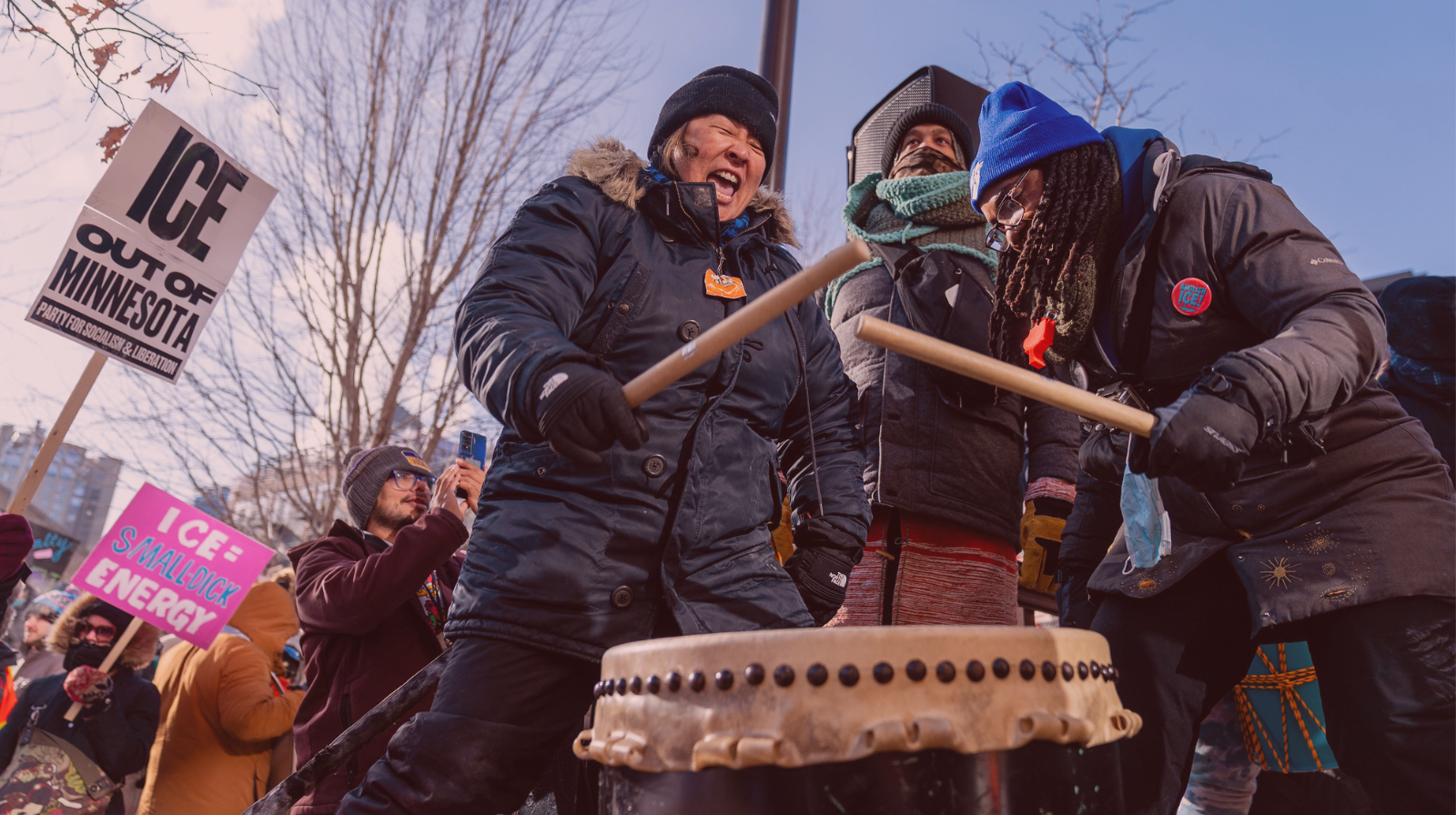
On January 23, 2026, in subzero temperatures, tens of thousands of Minnesotans refused to go to work. They refused to shop. They refused to send their children to school. Across the Twin Cities, over 700 businesses shuttered their doors in solidarity with what many would call the first general strike in the United States in nearly eighty years. A broad coalition of unions, faith leaders, and grassroots organizations had spent weeks coordinating the action, galvanized by the January 7 killing of Renée Good, a 37-year-old mother shot by an ICE agent while observing a raid in her neighborhood. By nightfall, marchers filled Target Center in downtown Minneapolis.
The next morning, federal agents shot and killed Alex Pretti, a 37-year-old ICU nurse and union member, outside a donut shop on Nicollet Avenue. Within hours, calls for another general strike flooded social media. (Fox News, with characteristic subtlety, described this as a “classic communist tactic” aimed at “paralyzing civil society.” One wonders if they apply the same framing to the Boston Tea Party.)
The phrase “general strike” now circulates with a frequency that would have seemed implausible even five years ago. It appears in protest chants, fundraising emails, union press releases, group chats, and social media comments among people who have never belonged to a union. Minneapolis proved a local general strike is possible.
But can this movement go national? That question is worth taking seriously. Solidarity actions caught fire across the country within days of January 23, conveying a visceral anguish about how people experience power today and how desperately they want to interrupt systems that no longer respond to ordinary demands.

What Made Past General Strikes Work
The general strikes that transformed American labor relations in the twentieth century emerged from years of patient organizing, dense networks of union membership, and institutional infrastructure capable of sustaining economic pressure over weeks or months. However they appeared from the outside, these were never spontaneous eruptions of popular anger.
In 1934, Minneapolis, the same city now convulsed by ICE operations, witnessed one of the most consequential labor battles in American history. That spring, Teamsters Local 574 had organized 3,000 workers into an industrial union. When employers refused to recognize the union, drivers walked out and brought all trucking to a standstill in a city that served as the Upper Midwest’s major distribution hub. Within days, 35,000 building workers walked out in sympathy. Police violence against the strikers, culminating in the “Bloody Friday” shootings of July 20, only deepened public support for the workers. When the strike ended in August, workers had won union recognition, a minimum wage, and the right of the union to represent all its members. Minneapolis, long notorious as a “scab’s paradise,” became a union stronghold.
Twelve years later, in Oakland, California, a different kind of general strike emerged. On December 3, 1946, workers passing through downtown witnessed police escorting scab trucks through picket lines outside two department stores where mostly female clerks had been striking for union recognition. Spontaneously, truck drivers, streetcar operators, and passengers abandoned their vehicles. By nightfall, 130,000 workers had joined a “work holiday” that shut down commerce across the East Bay. Workers took control of downtown Oakland, directing traffic, deciding which businesses could operate, and organizing their own distribution of food and supplies. The city effectively stopped. Though union leaders ended the general strike after 54 hours, the action transformed Oakland politics. In the May 1947 elections, a coalition of the AFL, CIO, and NAACP won four seats on the nine-member city council in a sharp rejection of the anti-labor machine that had ordered police to escort strikebreakers. Within days of the election, the Retail Merchants Association recognized the clerks’ union.
These strikes succeeded because they could bring entire local economies to a halt. Dense union membership meant that walkouts actually stopped production. Geographic concentration ensured that economic pressure was felt immediately and inescapably, and institutional coordination allowed strikes to be sustained long enough to force concessions.The Oakland strike was the last general strike in American history. The following year, Congress passed the Taft-Hartley Act, which made sympathy strikes and secondary boycotts illegal. The legal and organizational infrastructure that had made general strikes possible began a long erosion that continues to this day.
The Terrain Has Shifted
The structural conditions that enabled twentieth-century general strikes have largely dissolved. Union membership has fallen to under 10 percent of American workers, and employment itself has fragmented, with 36 percent of employed Americans now identifying as independent workers according to McKinsey. These workers often lack a shared employer against whom to organize, a break room where grievances accumulate into solidarity, and/or an obvious target for collective demands
Yet the laundry-list of pressures workers face has only continued to accumulate and multiply. Housing costs consume an ever-larger share of income while healthcare remains tethered to employment for those lucky enough to have it. Scheduling algorithms dictate when and whether gig workers can earn a living, and workplace surveillance extends into homes and phones. For millions of workers in immigrant communities or with immigrant family members, the ordinary act of commuting to work now carries the risk of federal detention.
People feel squeezed everywhere, not just at work. This mismatch between diffuse pressure and concentrated power explains why the general strike idea has gained such traction, gesturing toward a form of collective muscle that once felt unrealistic. On January 23, the Twin Cities put it into motion.

Labor as Resistance
Petitions, marches, days of action, and boycotts are more commonplace across the landscape of political engagement. However, a general strike suggests something more conspicuous, disruptive, and undeniable.
Minnesota organizers initially framed their January 23 action as an “economic blackout,” acknowledging the legal risks that attend the word “strike” in a country where sympathy strikes remain illegal. But within hours of the shutdown, media outlets and participants were calling it a general strike.
What distinguishes recent general strike rhetoric from its historical antecedents is who is organizing and why. Across the country, calls are coming from cross-sector coalitions that bring together labor unions, faith communities, immigrant rights organizations, climate activists, and racial justice groups. But unlike twentieth-century strikes, the demands are rooted in social justice and political resistance rather than labor disputes. The Minnesota action reflects this shift, with more than 100 community organizations joining labor unions, faith leaders, and Indigenous groups to coordinate the January 23 shutdown. “Nothing runs without the working class in this country,” said Kieran Knutson, president of CWA Local 7250, “and today we’re going to show our power.” That power was civic rather than contractual, labor infrastructure deployed in service of broader resistance.
A nationwide version of what Minneapolis achieved remains, for most, aspirational. But within the labor movement, some are assembling the infrastructure to make it possible. UAW President Shawn Fain has been organizing toward a May 1, 2028, action since the union’s successful Stand-Up Strike in 2023. The UAW deliberately aligned its contracts with the Big Three automakers to expire on April 30, 2028, positioning the union to strike on International Workers’ Day. Fain has urged other unions to synchronize their contract expirations. “We want a general strike,” he said in January 2024. “We want everybody walking out just like they do in other countries.”The American Federation of Teachers passed a resolution supporting the May 2028 alignment, and other unions are reportedly considering similar coordination. By drawing on Minneapolis’ proof of concept, a nationwide coalition can potentially mobilize workers and citizens to achieve what was once considered impossible.

What This Moment Signals
On January 24, with thousands of federal agents already occupying Minneapolis, Border Patrol officers left Alex Pretti dead outside a donut shop on Nicollet Avenue. If corporations and governments can act with such extreme, total, unaccountable force, the appeal of an equally sudden response has its own grim logic. The day before, the January 23 action demonstrated that coordinated economic withdrawal remains possible under the right conditions: a unified coalition, a galvanizing injustice, institutional backing from unions and religious organizations, and a political moment that made the risks of action feel less daunting than the risks of silence. It also demonstrated the limits of such efforts, as Alex Pretti’s killing made devastatingly clear.
Now the calls are growing louder and broader. Solidarity actions spread to 300 cities across the country in the days following January 23. Labor and immigrant rights organizers plan to harness the impetus of the Minnesota action for a nationwide general strike on May Day.
To take nationwide general strike rhetoric seriously is to acknowledge the gap between desire and capacity. In 2024, only 271,500 workers participated in strikes of any kind, less than 0.16 percent of the American workforce. Replicating what Minneapolis achieved across the country would require significant investment and rigorous work throughout cities and states that don’t yet have the same infrastructure. Economic withdrawal, moreover, harms the most precarious workers first, and those who can least afford to miss a paycheck are poorly positioned to participate in prolonged work stoppages. Without strike funds, mutual aid networks, and legal support, calls for mass refusal risk becoming invitations to individual sacrifice. The dense union membership that sustained workers through the Minneapolis strike of 1934 was precisely what allowed that action to continue for months, a cushion today’s atomized workforce lacks.
Shawn Fain himself has acknowledged these constraints. “A general strike isn’t going to happen on a whim,” he wrote. “It’s not going to happen over social media. A successful general strike is going to take time, mass coordination, and a whole lot of work by the labor movement.”
What people are reaching for when they imagine a nationwide general strike is the belief that what the Twin Cities achieved can spread and coordinated action can force power to meet their demands. That desire is neither naive nor misplaced. It is a solid starting point, but it requires the slow, unglamorous work of building durable networks to translate longing into power.
Editor’s Note
This article was updated on February 4, 2026 to reflect differing views on whether January 23 constituted a general strike.
